NY Inspires Step by Step: How New York Districts Can Build a Local Assessment System
Midway through the third NY Inspires webinar, a teacher typed a question into the chat that every New York district will eventually have to answer: how does this work with five classes and 25 students in each? One hundred and twenty-five students. Six Portrait of a Graduate attributes. One school year.
The answer came from a former superintendent who has watched decades of New York reform come and go, and it was not “work harder.” It is near the end of this guide. First, the plan that makes it possible. Across three free sessions in fall 2026, the NY Inspires webinar series of Curriculum Genie brought together ten voices: superintendents from three states, a New York regional service leader, national project-based learning experts, and an ASCD author. They kept arriving at the same step-by-step plan, and two resources tie it together: the NY Inspires Local Assessment Blueprint and the NY Inspires Community of Practice.
The NY Inspires plan for districts, in six steps: (1) build a community coalition that owns the Portrait of a Graduate; (2) start from the units teachers already teach, with one or two attributes per unit; (3) turn selected unit tests into performance-based assessments; (4) coordinate coverage of all six attributes in grade-level PLCs; (5) collect evidence in a portfolio that teachers review and confirm; (6) grow teacher capacity step by step and give leaders a clear view of progress. Curriculum Genie’s Local Assessment Blueprint lays these steps out as one district system, and the Community of Practice helps teams build them together, starting January 2027.
What is NY Inspires, and what is the timeline?
NY Inspires is the New York State Education Department’s plan to change what it takes to graduate. It adopts a statewide Portrait of a Graduate, rethinks credits and learning experiences, moves toward one high school diploma, and changes the role of the Regents exams so students can show what they know and can do in more than one way: performance-based assessment, portfolio evidence, work-based learning and more. The Regents exams remain available, and proposed graduation changes take effect only after the Board of Regents acts. Along the way, NY Inspires calls on every New York district to build a local assessment design around the Portrait of a Graduate.
The timeline gives districts a planning window, and the webinar speakers urged leaders to use it now rather than wait for every detail. (For a month-by-month view, see The 2027 Countdown: How New York Districts Can Prepare for NY Inspires Today.)
- July 2025: the Board of Regents adopts the New York State Portrait of a Graduate.
- Phase 1, Installation (fall 2025 to summer 2027): districts build capacity.
- Phase 2, Initial Implementation (fall 2027 to summer 2029): the Portrait moves into daily instruction and local assessment.
- Phase 3, Full Implementation (fall 2029 on): starting with students who enter grade 9 that year, students demonstrate proficiency.
In the Fireside Chat, Tony Day, Executive Director of the Western New York Educational Service Council, described the shift in one line: the question moves from “did we teach it?” to “did students learn it?” The work of answering it moves from the state to each district, which designs its own local assessment system.
What is a Portrait of a Graduate, and what are New York’s six attributes?
A Portrait of a Graduate is a short picture of the skills and habits every graduate should leave school with. New York’s has six attributes: Academically Prepared, Creative Innovator, Critical Thinker, Effective Communicator, Global Citizen, and Reflective and Future-Focused, with Culturally Responsive-Sustaining Education at the center.
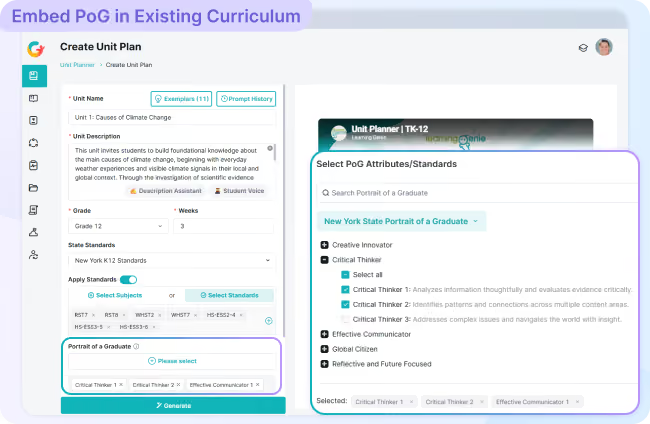
In Webinar 1, ASCD author Angela Di Michele Lalor drew a distinction that makes the Portrait teachable. Attributes are the broad categories, such as Critical Thinker. Competencies describe what an attribute looks like at a given grade and in a given discipline. New York defines a critical thinker as a graduate who analyzes information thoughtfully, evaluates evidence critically and identifies patterns and connections, which maps almost word for word onto the social studies practice of gathering and interpreting evidence. When the match is that close, the attribute fits into an existing unit instead of sitting on top of it.
What is the NY Inspires step-by-step plan for districts?
The six steps come from the NY Inspires Local Assessment Blueprint, the district model Curriculum Genie built for New York, and the speakers in all three sessions kept returning to them. Each step below matches a Blueprint chapter, so a district can see how the pieces connect before it starts. If your team is still gauging readiness, From Policy to Practice: Is Your District Ready for NY Inspires? is a good first read.
Step 1: Build a coalition that owns the Portrait
Ownership, not buy-in, is what lets the work outlast a leadership change. In the superintendent panel, Dr. Karen Cheser described how Durango School District 9-R engaged about 7,000 stakeholders, from an industry think tank to bus drivers to students at lunch in all 11 schools, then wrote success criteria with community members on the committees. Dr. Ray Sanchez of the Public Schools of the Tarrytowns keeps the Portrait visible in his weekly newsletter, board presentations and community visits. In the Blueprint, this is the superintendent-led District PoG and Local Assessment Design Council, with teachers and unions at the table from the start.
Step 2: Start from the units teachers already teach
Teachers do not need a new curriculum. In Webinar 1, the guidance was to choose one or two attributes per unit, the ones you will actually teach and assess, and spread all six across the year so students go deeper with each. Inside lessons, short Mini-Mastery activities of about 5 to 7 minutes give students regular practice with a micro-skill, such as explaining their reasoning and respectfully critiquing another solution in math.

Step 3: Turn selected unit tests into performance-based assessments
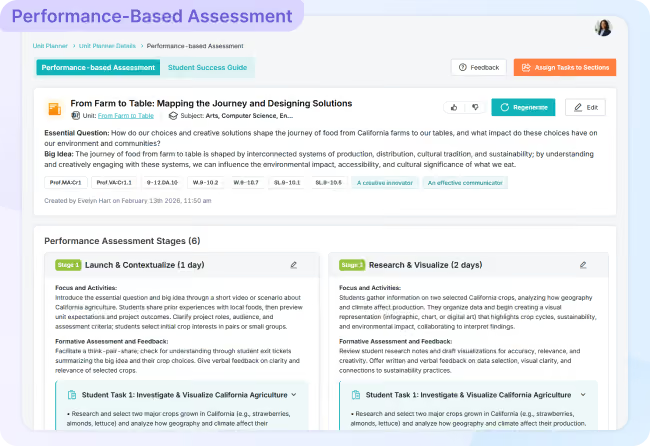
A unit-level performance-based assessment asks students to show learning through a project, presentation, investigation or real problem, and it captures both academic standards and Portrait competencies. The planning target in the Blueprint is flexible: about two unit-level PBAs per subject teacher per year, which across four or five core subjects gives each student 8 to 10 chances a year to demonstrate the competencies. A practical first move for next year is to swap one unit test for one PBA.
Step 4: Coordinate coverage in grade-level PLCs
No single teacher has to assess every attribute. Grade-level teams map which subjects lead which attributes, so ELA might lead communication, social studies global citizenship, and science critical thinking and creative innovation. The superintendents added a lesson in focus: when Durango’s teachers said the load was too heavy, the district cut its required success criteria from 24 a year to 8 per grade level, and Winters Joint Unified gave schools a full year to define what one competency looks like at each site.
Step 5: Collect evidence in a portfolio that teachers confirm
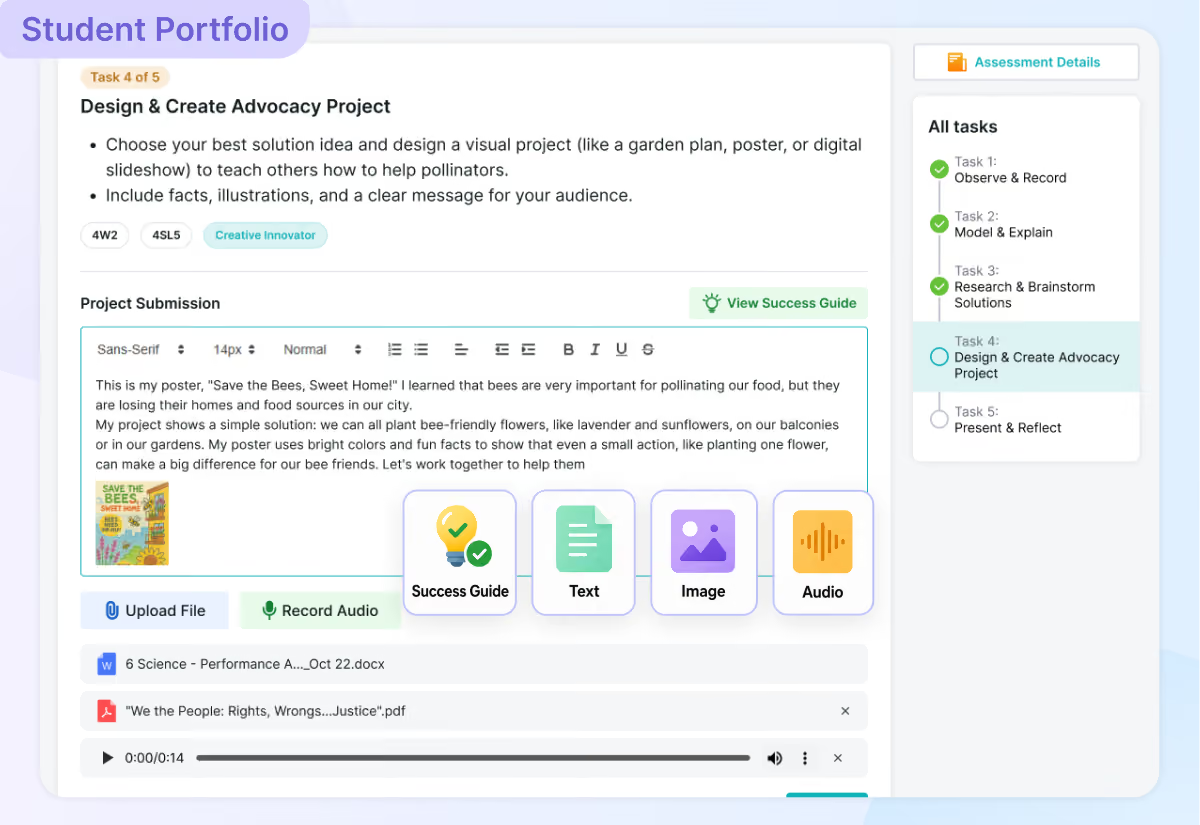
Evidence from Mini-Masteries, performance tasks, capstones and career-connected learning flows into one long-term student portfolio, linked to the lesson, standard, competency and rubric. AI can find evidence in student work and suggest a rating with its reasoning, but teachers review and confirm every consequential judgment, and shared exemplars and calibration keep a “proficient” meaning the same thing in every classroom.
Step 6: Grow teachers step by step, and give leaders a clear view
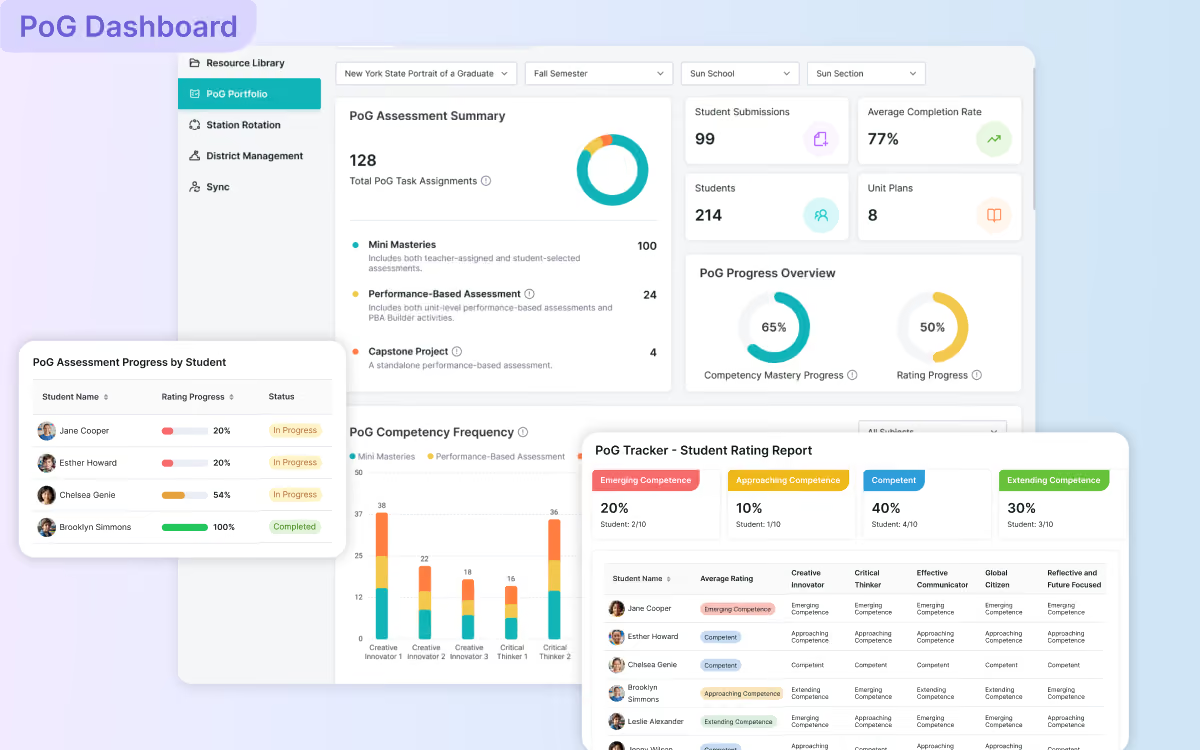
The PoG Belt System is a voluntary growth path from White Belt (aware) to Yellow (applies), Green (integrates) and Black (leads). It recognizes demonstrated classroom practice and stays separate from APPR. Webinar 1’s guiding phrase for the first step was “less, but real.” For leaders, a Portrait of a Graduate dashboard shows where each competency is practiced, how students are growing and where teachers need support, as an improvement tool rather than a ranking. The Blueprint phases all of this in: a 90-day launch, then foundations, coherence and scale over three years.
How do educators measure student progress toward Portrait of a Graduate competencies?
With shared rubrics applied to real student work, not checklists. Each competency is described at increasing levels, for example from Emerging to Extending, and teachers score performance tasks, projects, presentations and reflections against them. Three habits make the measurement trustworthy:
- Calibrate together. Teachers score the same work and agree on what each level looks like before scores count.
- Look at growth over time. A portfolio shows progress across units, subjects and years, so readiness is a progression rather than a single score.
- Keep three measures separate. A student’s participation, the completeness of their evidence and their demonstrated proficiency are different things, and the Blueprint keeps them apart.
Durango shows where this leads: students apply the competencies in regular coursework, upload evidence families can see, and present public capstones in grades 2, 5, 8 and 11 as a graduation requirement.
How can a teacher with 125 students make room for the Portrait?
By doing less of something else, not by adding the Portrait on top. That was Tony Day’s answer in the Fireside Chat, drawing on Doug Reeves: before you plant flowers, pull the weeds. As the Regents exams carry less weight for graduation, districts gain room to narrow the curriculum and go deeper. Tony also offered an early idea worth testing: a teacher might not guide all 125 students through their portfolios alone, but could be the advisor for about 25 of them.
The rest of the answer is the plan above. One or two attributes per unit. Five-minute practice inside lessons already on the calendar. Two performance tasks a year instead of a new course. Grade-level teams that share the load. Dr. Brandon Wiley added the encouraging part: these are exactly the questions a community of practice exists to work through together.
What is the NY Inspires Local Assessment Blueprint?
The NY Inspires Local Assessment Blueprint is Curriculum Genie’s district-wide model, delivered as a guided pilot with professional learning, that helps a district design, launch and sustain performance-based assessment starting from the curriculum it already uses. Its through line is everyday learning, authentic evidence, meaningful opportunities, so every student has a visible story of growth. Its eleven chapters join community ownership, classroom practice and district visibility into one system:
- Superintendent-led community coalition
- Curriculum-embedded Mini-Mastery
- Unit-level performance-based assessment
- Grade-level PLC coordination
- Advanced interdisciplinary capstones
- High school expansion into CTE and career-connected learning
- Progressive teacher professional development (the PoG Belt System)
- Unified student portfolio with AI-assisted, teacher-confirmed assessment
- Districtwide Portrait of a Graduate dashboard
- Phased implementation roadmap
- The student outcome: a demonstrated Portrait of a Graduate
For districts asking which framework to use to build a Portrait of a Graduate program, this is the practical difference: the Blueprint does not ask teachers to start over, and it keeps educators in charge of every judgment that matters for a student.
What is the NY Inspires Community of Practice?
The NY Inspires Community of Practice is a six-month design lab where New York district teams build their local assessment tools together, from January to June 2027. It is a co-initiative of Learning Genie and the Western New York Educational Service Council. Teams bring their existing curriculum and leave with tools they have field-tested, reviewed with peers and are ready to use.
- Four strands: Leadership, High School, Middle School and Elementary, each with a six-session playbook.
- Time: one 60-minute session a month, plus practical work between sessions and quarterly cross-strand sharing.
- Team: 2 to 4 people per district, including a decision-maker.
- Support: a shared resource hub, optional office hours, follow-up after every session, and complimentary Curriculum Genie Full Service for participants through the 2026–27 school year.
- Experts: leaders from across this series, including Dr. Karen Cheser, Lisa Weber, Dr. Brandon Wiley, Angela Di Michele Lalor, David Ross and Rhonda Hill.
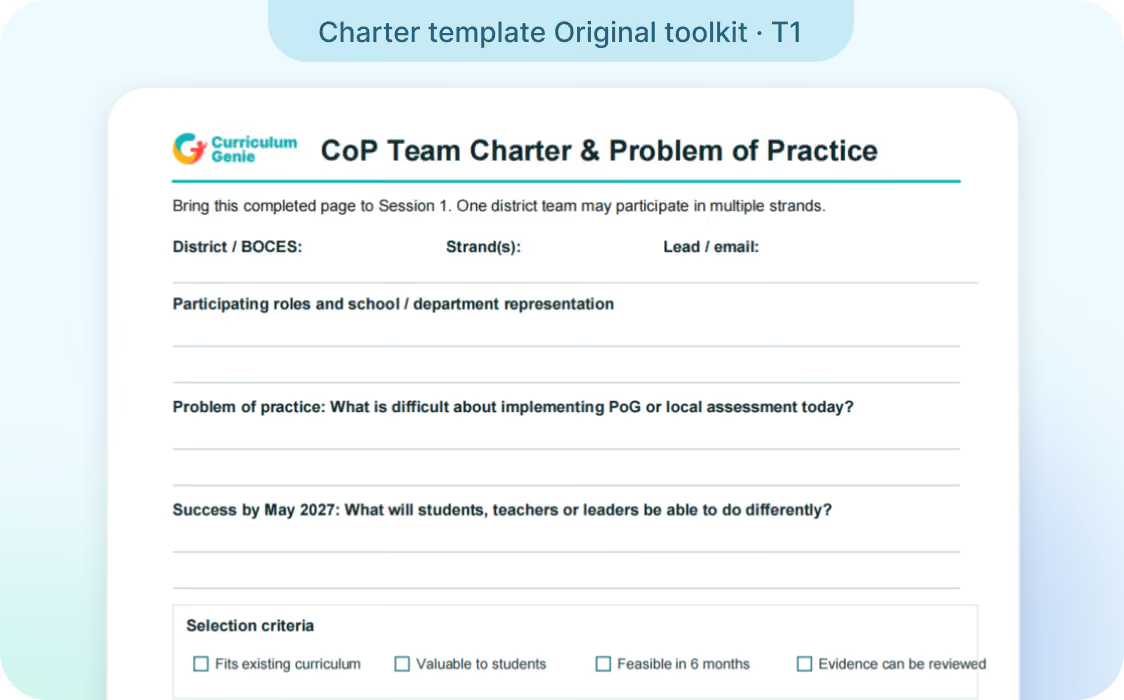
Every team leaves with at least one implemented or field-tested artifact, such as a performance task with its rubric or a district local assessment charter, plus a named owner and a 90-day plan.
Where can I watch the NY Inspires webinars?
All three sessions are free and on demand:
- Webinar 1: From Portrait to Practice: Build on What Already Works in Your Classroom · Angela Di Michele Lalor, David Ross and Dr. Gene Shi on embedding the Portrait in existing units, with the full slide deck.
- Webinar 2: Building a Community-Owned Assessment System That Lasts · Superintendents Dr. Karen Cheser, Dr. Rody Boonchouy and Dr. Ray Sanchez, moderated by Lisa Weber.
- Webinar 3: Where Districts Begin, a NY Inspires Fireside Chat · Tony Day, Dr. Brandon Wiley and Dr. Gene Shi, moderated by Rhonda Hill, plus a free virtual swag bag with three New York units and the Community of Practice Trainer Playbook.
Frequently Asked Questions
What is NY Inspires?
NY Inspires is the New York State Education Department’s plan to change what it takes to graduate. It adopts a statewide Portrait of a Graduate, rethinks credits and learning experiences, moves toward one high school diploma, and changes the role of the Regents exams so students can show readiness in several ways, including performance-based assessment and portfolio evidence. Proposed changes take effect only after the Board of Regents acts; until then, current requirements remain.
What is the NY Inspires timeline?
The Board of Regents adopted the New York State Portrait of a Graduate in July 2025. Phase 1, Installation (fall 2025 to summer 2027), is for building capacity. Phase 2, Initial Implementation (fall 2027 to summer 2029), brings the Portrait into daily instruction and local assessment. Phase 3, Full Implementation, begins in fall 2029, starting with students who enter grade 9 that year.
What are the six attributes of New York's Portrait of a Graduate?
Academically Prepared, Creative Innovator, Critical Thinker, Effective Communicator, Global Citizen, and Reflective and Future-Focused. Culturally Responsive-Sustaining Education sits at the center of the Portrait, and all six attributes are grounded in it.
What is a local assessment system under NY Inspires?
A local assessment system is a district’s own way of gathering evidence of Portrait of a Graduate competencies through classroom work, alongside state tests. It typically includes short practice routines, unit-level performance-based assessments, shared rubrics, calibrated scoring, student portfolios and leader dashboards, designed with the community so it lasts beyond any one leader.
How do educators measure student progress toward Portrait of a Graduate competencies?
With shared rubrics that describe each competency at increasing levels, applied to real student work: performance tasks, projects, presentations and reflections. Teachers calibrate their scoring together, collect evidence over time in a portfolio, and keep a student’s participation, evidence completeness and demonstrated proficiency separate. AI can suggest ratings, but educators make every consequential judgment.