Grade 4 · Science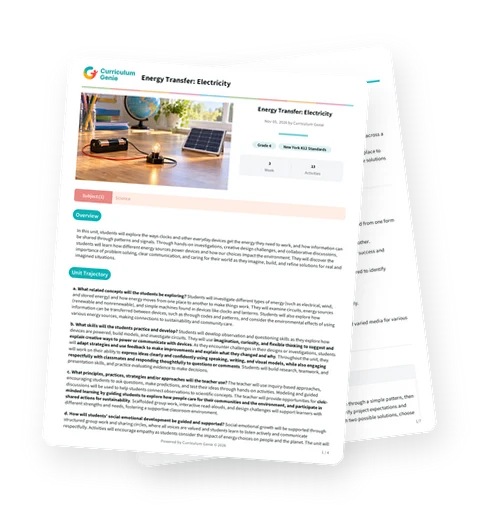
Energy Transfer: Electricity
3 weeks · 13 activities · NY K-12 standards
Unit PBA: Power It, Signal It!Design and test a device that uses energy to operate and send a signal across a distance.
Where should a New York district begin with NY Inspires? In this fireside chat, Tony Day (Western New York Educational Service Council), Dr. Brandon Wiley (former Chief Program Officer, PBLWorks) and Dr. Gene Shi (Learning Genie), moderated by Rhonda Hill, agree on a clear starting point: build from what already works, bring students in early, focus on one competency at a time, and design the local assessment system together. Curriculum Genie helps teachers embed Portrait of a Graduate skills and unit-level performance-based assessments into the units they already teach.
Webinar 3 of the NY Inspires webinar series, recorded on November 18, 2026, brought together principals, assistant superintendents, BOCES staff, teacher center directors, instructional coaches and board members. The conversation moved from the system level to the classroom: why this moment matters for New York districts, what has worked in schools already doing Portrait of a Graduate work, and how teachers can start without adding one more initiative to their plate. The resources shared in the session are in the Fireside Chat virtual swag bag just below the speakers.
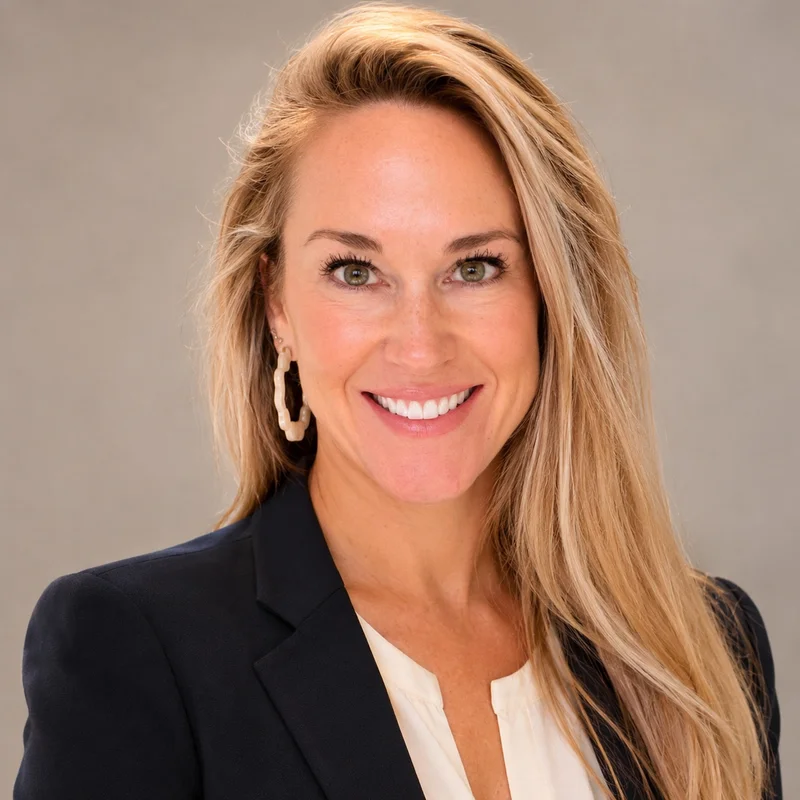 Rhonda HillModerator, Strategy and Leadership Consultant; former PBLWorks
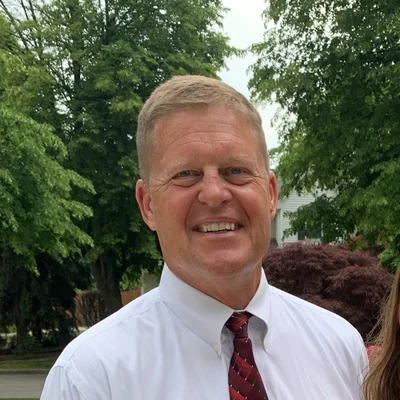 Anthony (Tony) DayExecutive Director, Western New York Educational Service Council
 Dr. Brandon WileyFormer Chief Program Officer, PBLWorks
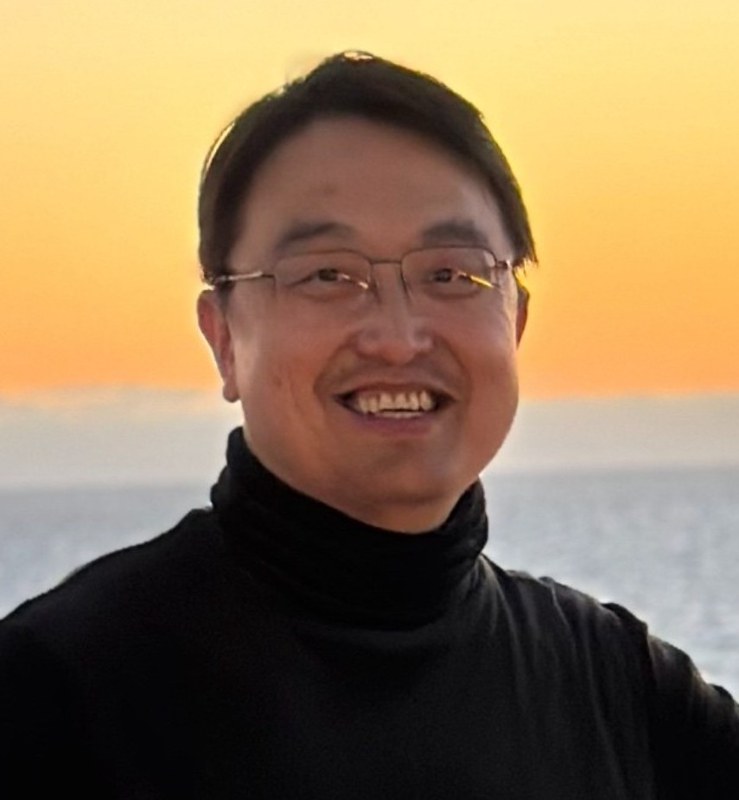 Dr. Gene ShiCo-Founder and CEO, Learning Genie
Three units built in Curriculum Genie for New York classrooms, each with a unit-level performance-based assessment tied to the New York State Portrait of a Graduate.
3 weeks · 13 activities · NY K-12 standards
Unit PBA: Power It, Signal It!Design and test a device that uses energy to operate and send a signal across a distance.
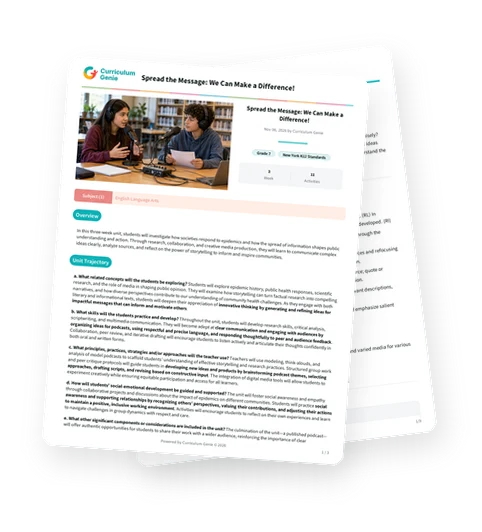
3 weeks · 11 activities · NY K-12 standards
Unit PBA: Podcasting the EpidemicUse research and storytelling to help others understand an epidemic and respond wisely.
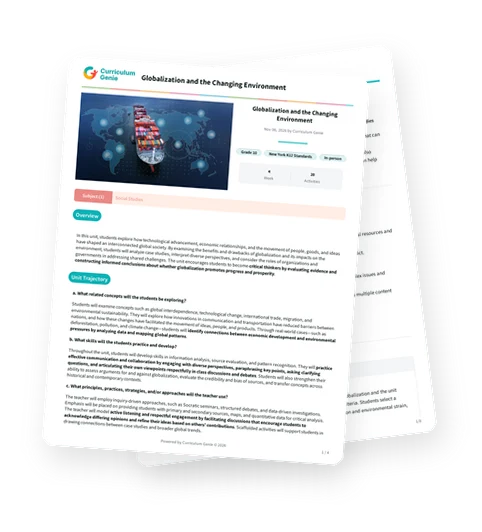
4 weeks · 20 activities · NY K-12 standards
Unit PBA: Global Sustainability Action PlanWeigh the benefits of globalization against its environmental costs and plan a response together.
Also in your bag
Because NY Inspires moves graduation from a single test toward evidence of what students can do. Tony Day began his career about 40 years ago as a high school social studies teacher, when the standards that followed A Nation at Risk first described what a graduate should be able to do. Those early standards already named creativity, effective communication and critical thinking, attributes that sit in today’s Portrait of a Graduate. The No Child Left Behind era then shifted the work toward testing and accountability, with one test used to compare schools and districts.
Under NY Inspires, students still take the Regents exams and the grades 3 through 8 state tests, but the state plans to stop using a single exam as the gate to a diploma. Graduation moves toward an evidence-based system: not seat time or a 65 on one test, but students applying what they know, communicating, creating and taking on real problems. The work shifts from the state to each district, which designs its own system of assessment. Tony sees tremendous opportunity in that for students, and encouraged leaders to treat this as a time to act rather than wait.
Students become active partners in their own learning. Tony described the shift as moving the question from “did we teach it?” to “did students learn it?”, with students choosing what they work on and which evidence shows their competency. Their role changes from receiving information to creating knowledge, and the Reflective and Future Focused attribute matters most here: knowing what to learn next, how to learn it and how to get feedback.
Tony saw this firsthand in the Sweet Home Central School District, where the Leader in Me program had students building their own portfolios, leading their own parent conferences and serving as accountability partners for classmates. A 14-year-old will still need teachers to help decide what goes in a portfolio and why. And because guidance from the state will keep arriving, Tony compared the work to an airplane already in flight: districts set their own vision now and adjust as they learn more.
Teachers are furthest along, and students and families are the next frontier. Asked how familiar each group is with their Portrait of a Graduate, 70% of attendees said their teachers are somewhat familiar, 53% said the same of their boards, 50% said families are not yet familiar and 40% said students are not yet familiar. Asked for the first word that comes to mind with NY Inspires, attendees answered transformation, progress, opportunity, equity, authentic learning, agency, innovation and uncertainty.
Rhonda Hill framed the takeaway: the portrait is a promise to students, so students need to be able to describe what it looks like to be an effective communicator or a creative innovator, and what they can do to show they are becoming one.
Drawing on a Western New York Portrait of a Graduate day with about 80 administrators the day before, Tony offered six pieces of advice:
One participant summed up the practical path in the chat: choose one attribute, define what it looks like at your grade level, identify the evidence students can produce, and notice where classrooms already create those opportunities.
Every school has a different entry point, and the strongest ones start from assets. Dr. Brandon Wiley, now based in Las Vegas, supports a statewide community of practice where schools from several Nevada districts implement a Portrait of a Learner together. Nevada has not tied its portrait to assessment policy the way New York has, which gives New York districts a lever Nevada doesn’t have. Schools name the practices that already serve students well, then make them consistent so every student experiences them, not only the students who happen to have a particular teacher.
Every school visit starts with students. In listening sessions, students may not know the word “portrait,” but they can describe which classes build which skills and what works for them. Schools then turn the attributes into look-fors and student-friendly “I can” statements so students can self-assess. Each school picks one thing to pilot this year, from student reflection tools to the master schedule, because a schedule shows what a school values. Rhonda added that look-fors should set the floor, not the ceiling, so students and teachers can keep showing more.
Brandon’s reframe: start as a listener and let the portrait answer a need your community already has. Talk with students, families and community partners, including partners you hope to work with, about what they see in your graduates. When the work is only about implementing the portrait, it feels like compliance. When it starts from what the data says your community needs, the portrait becomes the way to get there, and surveys and forums grow awareness at the same time.
Look for momentum already in the building, without asking the same early adopters to carry everything. Start small: one change before winter break, another by the end of the year. For teachers, keep it concrete, for example one practice from Brandon’s free Deeper Learning Practices framework as a PLC focus. Performance-based assessment is a strong starting point when the instruction leading up to it changes too, and senior capstones need scaffolding in the years before. Brandon acknowledged the time and resources this takes, and framed it as continuous improvement: decide what to be tight and loose on, and build coherence, not uniformity. Rhonda suggested bringing alumni into the listening, as one district did by inviting graduates to speak at teacher induction.
Listen, set a baseline, define one sprint of work, and get teachers trying something. Brandon’s 90-day sequence:
By the end of a semester, a school with shared language, baseline data and teachers trying something has made a strong start.
By doing less of something else, not by adding the portrait on top. A teacher in the chat asked how this works with five classes and 25 students in each. Tony’s answer drew on Doug Reeves: before you plant flowers, pull the weeds. Districts will make decisions about narrowing the curriculum and going deeper, and as the Regents exams carry less weight for graduation, there is room to do that.
Tony offered an early idea rather than a final answer: a teacher might not move all 125 students to the portrait alone, but could be the guide for about 25 of them, helping them decide what goes in their portfolios and why. Brandon added that these are exactly the questions a community of practice exists to work through.
It is collaborative, not just cooperative. Tony described it as the PLC concept applied across districts: teams name what they want to learn up front, then generate ideas, test them, share results and build together. Brandon added that leaders are feeling uncertainty and healthy skepticism, and a community of practice gives them a space to work through it with like-minded peers instead of in isolation, from designing performance-based assessments to rethinking how a district reports learning to higher education.
The first New York cohort will be shaped by the questions districts bring, with groups for district leaders and for elementary, middle and high school teachers. The chat from this session is being used to plan its content.
Across the hour, the panel kept returning to the same six challenges. Each one points to something a district system has to make easier for teachers, not harder.
Dr. Shi said BOCES and district leaders most often ask where to begin, and Tony urged districts to start now rather than wait for more state guidance.
Teachers load a current unit, and Curriculum Genie shows its standards and where Portrait of a Graduate attributes already fit, so the work builds on current practice.
Dr. Shi named the time teachers need to build new skills, and a teacher in the chat asked how this works with five classes and 125 students a day.
Curriculum Genie drafts performance-based assessments and rubrics. Teachers review, edit and approve every draft and make every call.
Tony noted how much assessment literacy a local plan takes, and that the curriculum behind the portrait needs to be clear before the assessments are.
Each task aligns academic standards and Portrait of a Graduate competencies, with clear learning targets and competency rubrics.
Dr. Shi stressed that the Regents exams and grades 3 through 8 state tests remain, so academic standards still matter.
Academic standards and portrait subskills are designed into the same unit, so teachers plan one coherent learning experience.
Dr. Wiley described strong practice that depends on which teacher a student happens to have.
Grade-level teams map which attributes each subject covers across New York’s six Portrait of a Graduate attributes and share rubrics and exemplars.
In the live poll, 40% of attendees said their students are not yet familiar with their Portrait of a Graduate.
5 to 7 minute Mini-Mastery activities build portrait skills inside lessons teachers already teach, and students submit evidence against clear success criteria.
The panel was clear that listening, coalition building and leadership come first, and no tool replaces that. Curriculum Genie supports the classroom side: it starts from the curriculum teachers already have, helps them embed Portrait of a Graduate competencies, collects student evidence, and gives leaders a clear view of growth.
It starts with the units teachers already teach. A teacher loads a current unit, and Curriculum Genie shows its standards and breaks each Portrait of a Graduate attribute into smaller subskills. Short Mini-Mastery activities, about 5 to 7 minutes, then give students regular practice with a competency inside a lesson they are already learning.
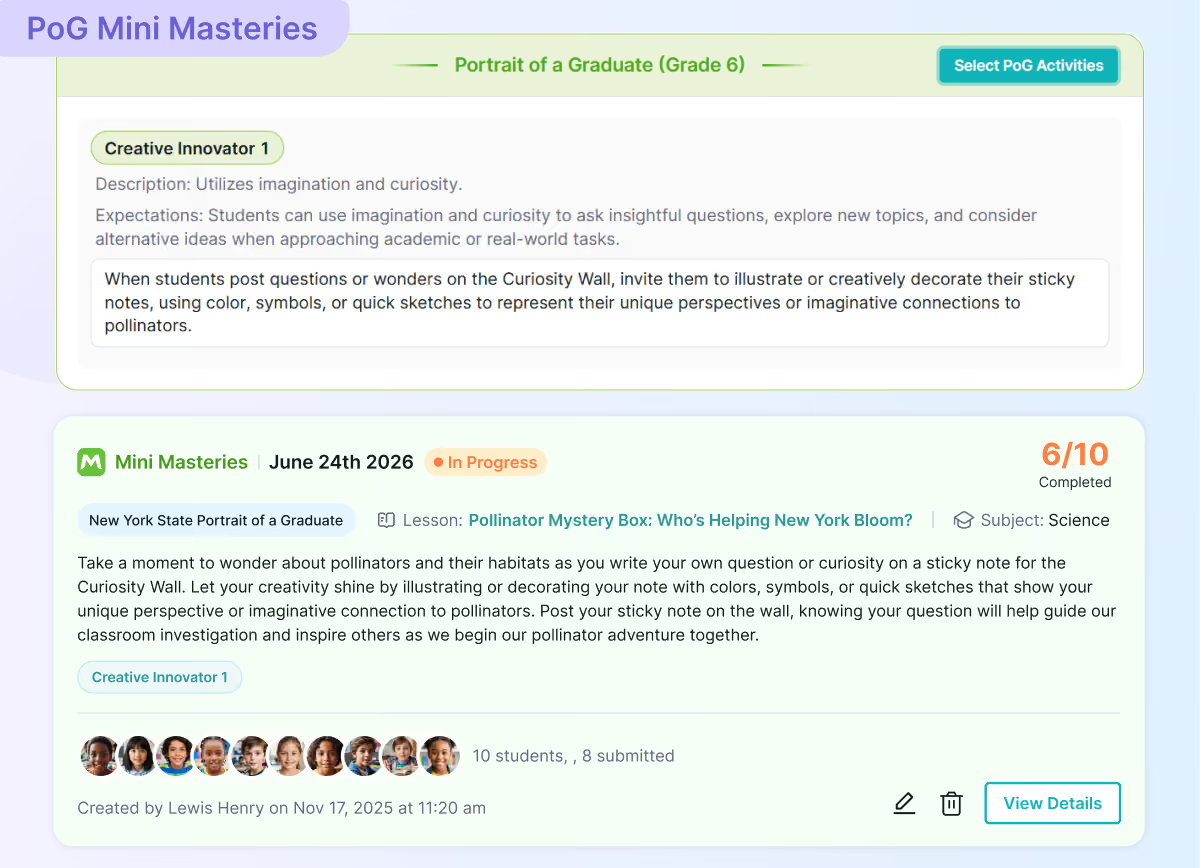
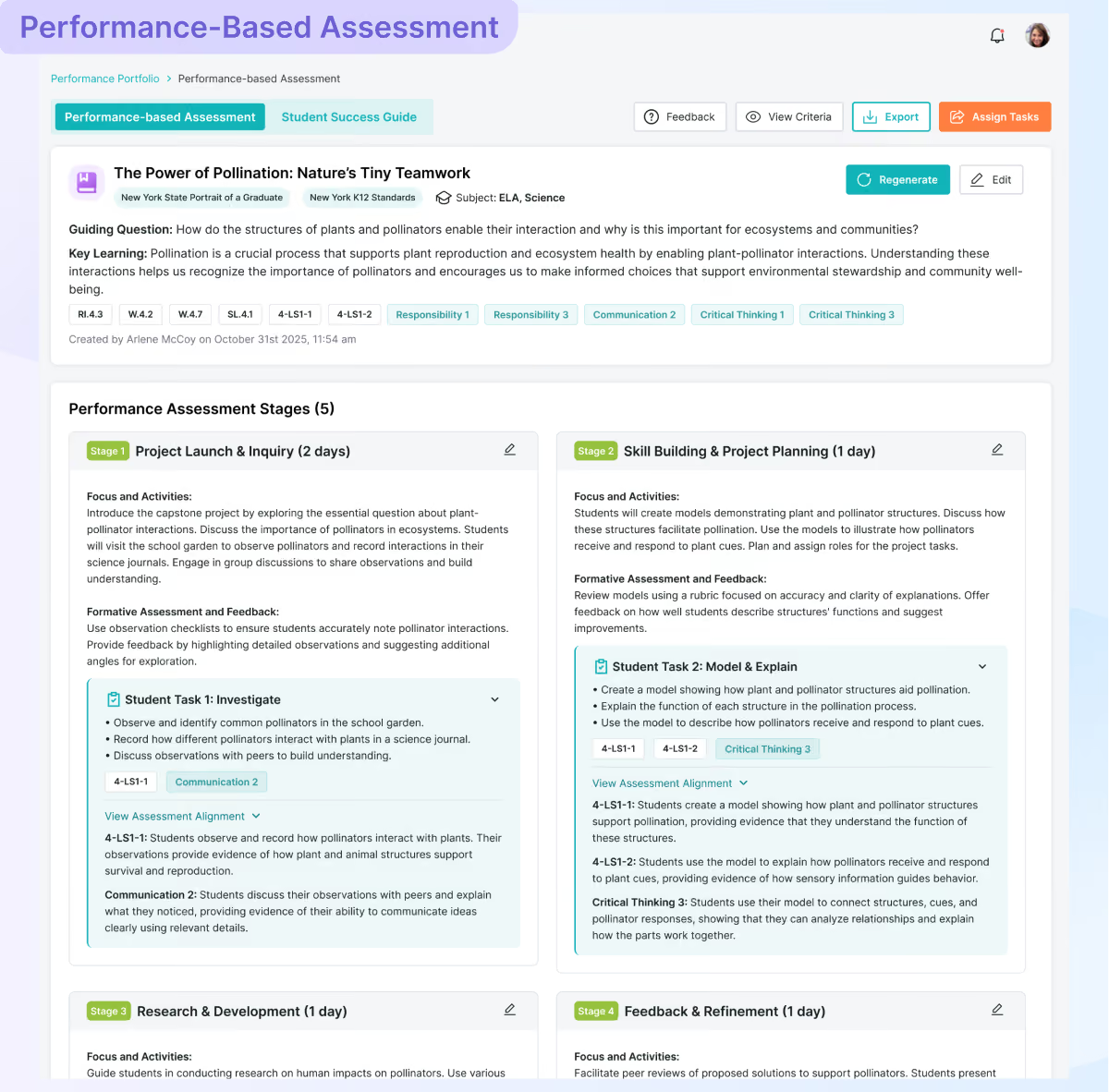
In grade-level PLCs, teachers audit their units for the year together and decide who leads which attributes. A social studies or ELA teacher may lead global citizenship, while every subject can build critical thinking and creative innovation. A team might plan about two unit-level performance-based assessments per teacher across the year, and a practical first step for next year is to swap one unit test for one. Each assessment aligns academic standards and portrait competencies across its stages.
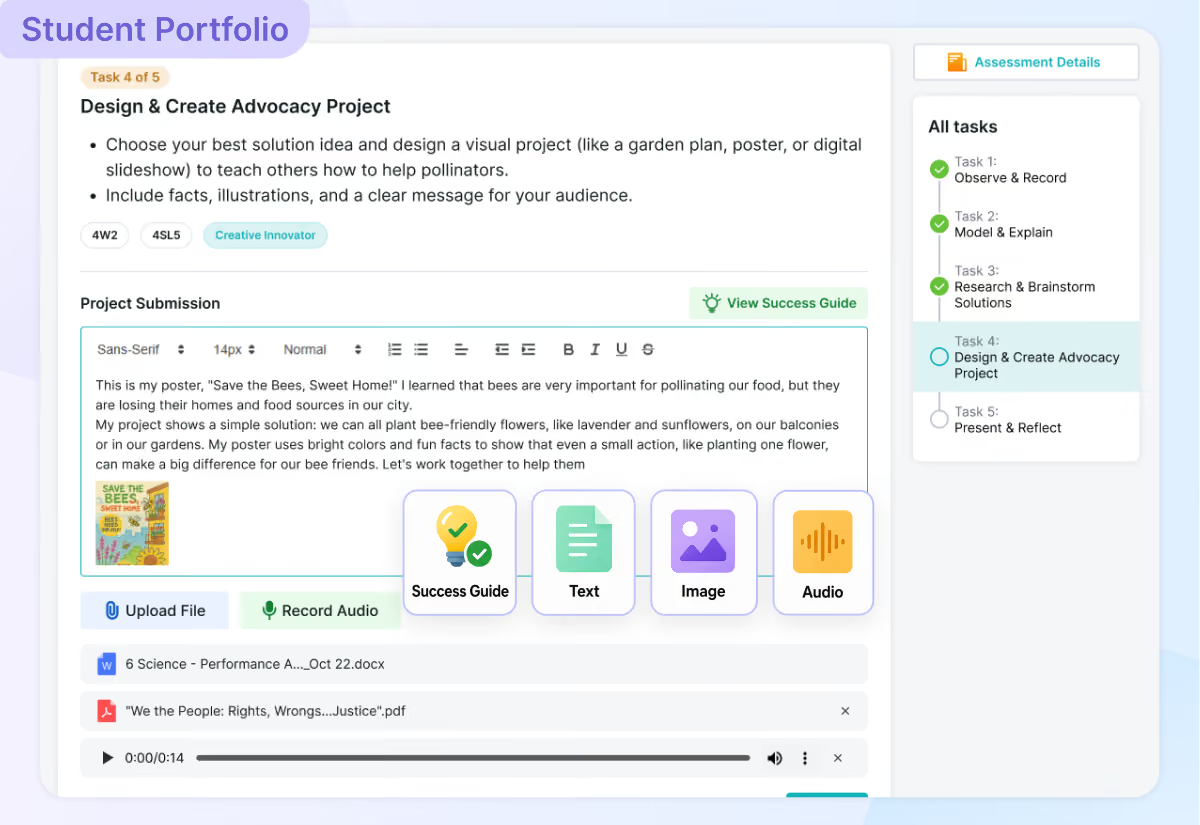
Students then show what they can do. They submit evidence in text, images, audio or files, guided by clear success criteria, so the portrait becomes something students can describe and demonstrate, not just a poster on the wall.
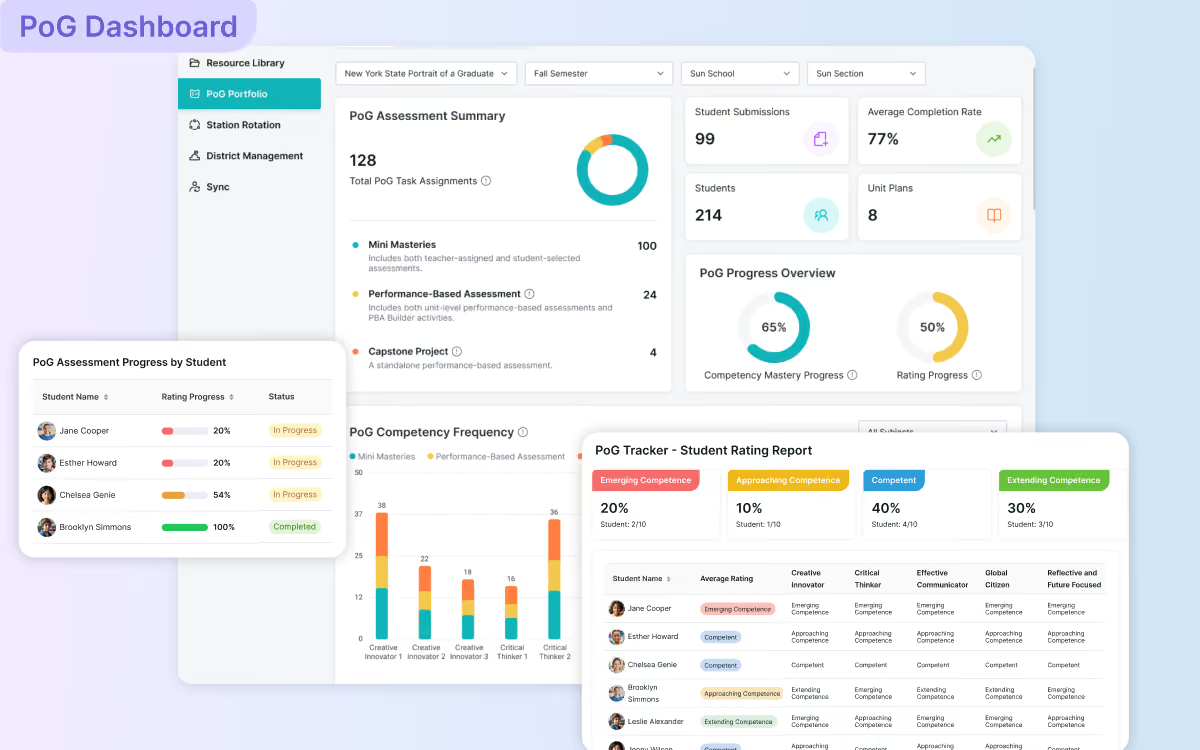
Leaders see the whole picture. A Portrait of a Graduate dashboard shows where each competency is being practiced and how students are rated from Emerging to Extending, so districts can see where the portrait is showing up in classrooms and where teachers need support.
Curriculum Genie is validated at ESSA Evidence Tier 3 in a Johns Hopkins University study, and Learning Genie is New York Education Law 2-d compliant. Student data is not used to train AI models. The NY Inspires Local Assessment Blueprint shows how the pieces fit together across a district.
For more from this series, watch Webinar 1, From Portrait to Practice: Build on What Already Works in Your Classroom, and Webinar 2, Building a Community-Owned Assessment System That Lasts.
A recorded conversation for New York educators on where districts should begin with NY Inspires and the Portrait of a Graduate. Tony Day, Dr. Brandon Wiley and Dr. Gene Shi, moderated by Rhonda Hill, cover why this moment differs from past reforms, what works in schools, a principal’s first 90 days, and how Curriculum Genie helps teachers build portrait skills into the units they already teach.
Start now and start from strengths. Build a shared understanding of what each attribute means with staff, students and families, look at what already works, form a guiding coalition, and focus on one attribute: define what it looks like at your grade level and the evidence students can produce. Learn alongside other districts in a community of practice.
Listen and set a baseline: map where the competencies already appear in curriculum and instruction, hold short student listening sessions and do focused classroom walks. Then draft grade-level look-fors or student-friendly I can statements, use PLC and PD time for these conversations, invest in teacher leaders, and have teachers try one small move and bring student work back to discuss.
Curriculum Genie starts from a teacher’s existing unit. It breaks Portrait of a Graduate attributes into teachable subskills, embeds them alongside the academic standards, and helps teams plan unit-level performance-based assessments across a grade level. Teachers review and approve every draft. It is validated at ESSA Evidence Tier 3 in a Johns Hopkins University study.
Three Curriculum Genie units for grades 4, 7 and 10, each with Unit Foundations and a unit-level performance-based assessment, plus the NY Inspires Community of Practice Trainer Playbook, the NY Inspires Local Assessment Blueprint, the Community of Practice and our research and evidence page. Fill in one short form with your name, work email, role and school or district once, and every file in the bag opens right away.
Curriculum Genie helps teachers build Portrait of a Graduate attributes and performance-based assessments into the units they already teach.