


JAN 2027
Team charter + one priority challenge
Kickoff: define district problem, baseline, state timeline, CoP norms
POLICY COMPASS
Use official NYSED guidance as the source of truth. Proposed changes must not be described as already-effective requirements.
| STUDENT GROUP | 2026–27 STATUS | CoP DESIGN IMPLICATION |
|---|---|---|
Class of 2028(current grade 11) | Proposed transition to one diploma and sunsetting passing requirements for Regents exams for graduates beginning Jan. 2028, pending regulatory action. | Counselors verify current requirements; build a local assessment inventory and student/family FAQ. |
Class of 2029(current grade 10) | Same proposed graduation transition; more time to pilot PBAs, portfolio routines, and career exploration. | Build coherent grade 10–12 learning and assessment pathways. |
"2029 Cohort"(enters grade 9 in fall 2029) | Distinct from graduating Class of 2029. This entry cohort is slated for the full PoG-aligned competency framework and universal transcript. | Middle schools prepare progression and handoffs; high schools develop future system capacity. |
| ADOPTED CONTENT | HIGH SCHOOL | MIDDLE | ELEMENTARY |
|---|---|---|---|
Personal finance education | 2026–27 | 2026–27 (grades 5–8) | 2027–28 (K–4) |
Climate education | 2027–28 | 2027–28 (grades 5–8) | 2028–29 (K–4) |
These adopted content timelines create useful curriculum entry points. They are not a statewide requirement to implement PoG in every classroom in 2026–27.
See how districts across New York are designing local assessment systems aligned to Portrait of a Graduate.
Explore Local Assessment Blueprint →THE SIX-MONTH JOURNEY
Recommended launch: joint orientation in January 2027; monthly working sessions through June 2027.
TEAM WORK PRODUCT / COMMON LEARNING CYCLE
JAN 2027
Kickoff: define district problem, baseline, state timeline, CoP norms
FEB 2027
Audit existing curriculum and assessments; use curriculum mapping to connect current units with NY Inspires PoG competencies and strengthen curriculum alignment.
MAR 2027
Design Mini-Mastery routines and one rigorous PBA; cross-strand peer review
APR 2027
Plan evidence capture, student voice, student supports, and scoring calibration
MAY 2027
Field-test proposed changes, review student-work evidence, and work with district stakeholders to plan next steps for curriculum implementation in a 90-day sprint.
JUN 2027
Showcase: artifact, improvement story, and scaling commitment

STRAND PLAYBOOKS
LeadershipHigh SchoolMiddle SchoolElementary
Six-session workplans for every team.
STRAND PLAYBOOK / 01
Driving question: How does a district build a trusted, coherent local assessment system that lasts beyond the launch year?
Recommended team
Superintendent or designee; curriculum/assessment leader; principal; teacher and association representatives; optional BOCES, student and family advisors.
Experienced education leaders bring expertise in district transformation, strategic planning, and organizational leadership.

Founder, Creative Futures Collaborative · Former Superintendent
Advancing student-centered learning and educational innovation.

Superintendent, Durango School District 9-R, Colorado
Led district transformation and advanced career-connected learning.

Moderator, Former Assistant Superintendent, New York
Advancing curriculum innovation and instructional leadership.
Leadership Capacity & PoG Strategy
Former state education leader. Guides districts through organizational change.

Former Chief Program Officer, PBLWorks
Nearly 30 years in education; expert in school transformation, strategic planning, and deeper learning.
| Session | DESIGN CHALLENGE | OUTPUT |
|---|---|---|
| 1 | Establish a shared PoG vision, baseline, and decision rights | District purpose + leadership charter |
| 2 | Inventory existing assessments, instructional initiatives, and burdens | Local assessment system map |
| 3 | Co-design coalition / town hall meeting participation with teachers/unions, students, families, local employers, local universities/colleges | Stakeholder/union engagement map |
| 4 | Agree on learning evidence standards, scoring moderation, equity and privacy | Assessment and data governance principles |
| 5 | Plan tiered teacher development, time, budget, support and dashboard | Year-one operating plan + KPIs |
| 6 | Rehearse board/community presentation and agree on next decisions | Board-ready executive brief + 90-day priorities |
A concise local assessment charter, coalition governance map, baseline scorecard and 90-day plan.
STRAND PLAYBOOK / 02
Two tracks inside one strand: near-term Classes of 2028/2029 and longer-term competency-based system capacity.
Book a Demo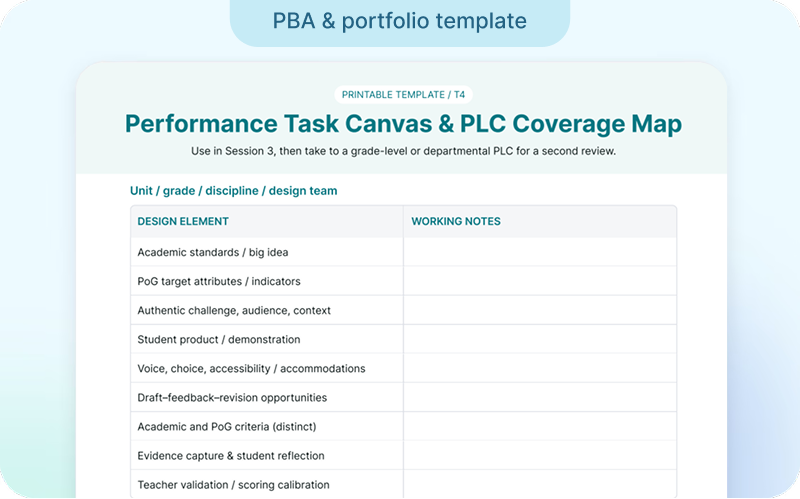
Explore how national experts support deeper learning, career readiness, PBL, and performance-based assessment.

Teacher Capacity & PBA
ASCD author of Ensuring High-Quality Curriculum. 25+ years in curriculum coherence.

PBL & the Belt System
Former Buck Institute Senior Director and P21 CEO. Architect of the Belt Achievement Framework.
Leadership & PBL
Expert in district transformation and establishing sustainable systems; Strengthens leadership capacity through an asset-based coaching lens
Teacher Leader & Administrator Coaching
Co-author of Pedagogies of Voice. Developer of the Human-Centered Pedagogy Framework.
| Session | WORKSHOP | OUTPUT |
|---|---|---|
| 1 | Map cohort-specific graduation readiness and official guidance | Cohort impact / counselor FAQ |
| 2 | Inventory existing units, Regents/state tests, course assessments and work experiences | Local assessment evidence map |
| 3 | Convert a selected unit assessment into rigorous standards + PoG PBA | PBA, rubric and accessible options |
| 4 | Connect CTE, personal finance, career exploration, community and work-based learning | Authentic partner brief / experience rubric |
| 5 | Build student reflection, portfolio curation, teacher validation and moderation | Student portfolio and scoring protocol |
| 6 | Peer review transition playbook and share examples | High School Assessment Transition Pack |
Cohort-specific graduation transition checklist, district local assessment map, 1–2 reviewed PBAs, career-readiness evidence rubric, portfolio/advisory routine and family FAQ.
STRAND PLAYBOOK / 03
Driving question: What should students learn and demonstrate in grades 6, 7 and 8 before high school?
Book a Demo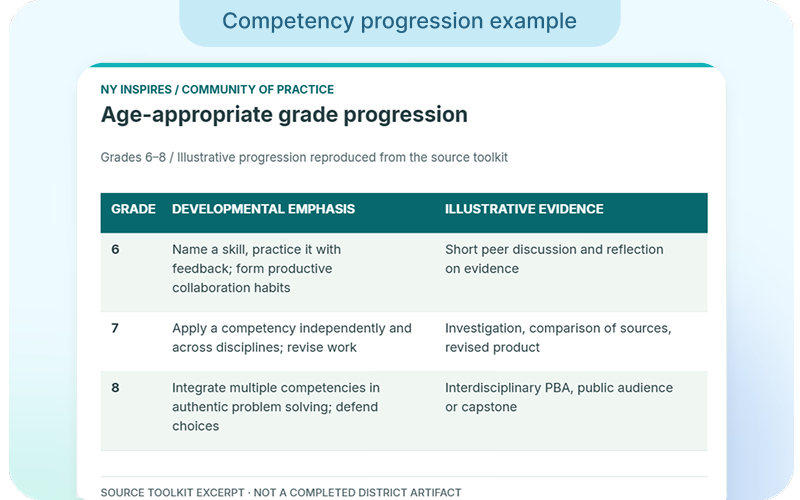
Build a coherent PoG progression with guidance on student agency, competency development, and project-based learning.
Teacher Capacity & PBA
ASCD author of Ensuring High-Quality Curriculum. 25+ years in curriculum coherence.
PBL & the Belt System
Former Buck Institute Senior Director and P21 CEO. Architect of the Belt Achievement Framework.
Leadership & PBL
Expert in district transformation and establishing sustainable systems; Strengthens leadership capacity through an asset-based coaching lens
Teacher Leader & Administrator Coaching
Co-author of Pedagogies of Voice. Developer of the Human-Centered Pedagogy Framework.
| Session | WORKSHOP | OUTPUT |
|---|---|---|
| 1 | Choose grade-band PoG indicators in student-friendly language | 6–8 competency progression |
| 2 | Map existing units by subject, with primary and supporting PoG traits | Grade-level PLC coverage map |
| 3 | Embed two 5–7 minute Mini-Mastery routines into current lessons | Test-ready routine cards |
| 4 | Develop a unit PBA with multiple forms of student evidence | PBA + rubric and accommodations |
| 5 | Review student work, moderate rubric judgments, and sketch optional capstone | Calibrated exemplars and capstone option |
| 6 | Align eighth-grade evidence to ninth-grade handoff | Transition profile + scaling plan |
| GRADE | DEVELOPMENTAL EMPHASIS | ILLUSTRATIVE EVIDENCE |
|---|---|---|
| 6 | Name a skill, practice it with feedback; form productive collaboration habits | Short peer discussion and reflection on evidence |
| 7 | Apply a competency independently and across disciplines; revise work | Investigation, comparison of sources, revised product |
| 8 | Integrate multiple competencies in authentic problem solving; defend choices | Interdisciplinary PBA, public audience or capstone |
"Should our community change how it uses water?" Science evaluates environmental evidence; Math models use; ELA develops arguments; Social Studies studies local policy. Teams select a manageable scope and distinguish academic criteria from PoG criteria.
Grade 6–8 progression, a schoolwide or grade-level coverage map, two Mini-Mastery prototypes, one reviewed unit PBA, a portfolio reflection routine and grade-8 transition evidence proposal.
STRAND PLAYBOOK / 04
Driving question: How can we help younger learners practice PoG skills through familiar, joyful, standards-aligned learning?
Book a Demo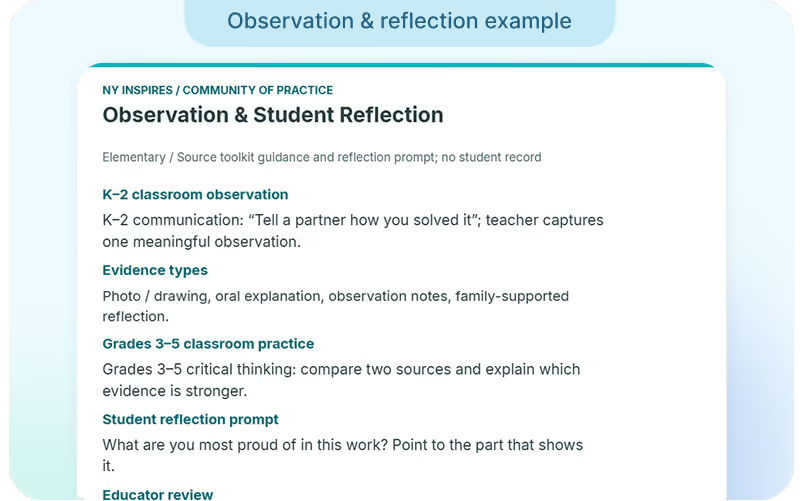
Expertise in elementary curriculum, teacher capacity, and performance-based assessment supports strong learning foundations.
Teacher Capacity & PBA
ASCD author of Ensuring High-Quality Curriculum. 25+ years in curriculum coherence.
| Session | WORKSHOP | OUTPUT |
|---|---|---|
| 1 | Translate PoG attributes into age-appropriate look-fors | K–2 and 3–5 examples |
| 2 | Map competencies to existing literacy, math, inquiry and classroom routines | Curriculum integration map |
| 3 | Create low-burden Mini-Mastery prompts and teacher observations | Two routines by grade band |
| 4 | Design one authentic integrated unit task with accessible responses | Simple PBA + success criteria |
| 5 | Prototype child-friendly reflection, family input and privacy-safe portfolio | Evidence + family communication protocol |
| 6 | Review classroom evidence and agree on grade-band progression | Elementary implementation pack |
| BAND | TEACHING MOVE | EVIDENCE TYPE |
|---|---|---|
| K–2 | Model and name the skill through stories, play, talk, drawing, exploration and teacher observation. Micro-routines may be shorter than 5 minutes. | Photo / drawing, oral explanation, observation notes, family-supported reflection. |
| 3–5 | Use 5–7 minute Mini-Mastery routines, simple student rubrics, problem-solving, collaboration, and small authentic projects. | Written or recorded explanation, revised product, group task, student self-assessment. |
Join the January 2027 cohort with your district team, or explore the full NY Inspires platform to see what districts are building across New York.