NY Inspires in Practice: Embed the Portrait of a Graduate in the Units You Already Teach
NY Inspires asks every New York district to make the Portrait of a Graduate real in classrooms, not just on the wall. In this session, curriculum author Angela Di Michele Lalor, former P21 CEO David Ross and Learning Genie CEO Dr. Gene Shi show how teachers embed Portrait of a Graduate attributes and curriculum-embedded performance-based assessment into the units they already teach, without starting over.
Principals, assistant superintendents, curriculum directors, BOCES leaders, board members and classroom teachers from across New York joined Webinar 1 of the NY Inspires webinar series. The message was practical: the shift to competency-based education is large, but teachers do not need a new curriculum. They need a clear way to see their existing units through the lens of the Portrait of a Graduate, one performance task at a time.
Who presented this NY Inspires webinar?
- Angela Di Michele Lalor, Senior Consultant, Learner-Centered Initiatives. Author of the ASCD books Ensuring High-Quality Curriculum and Making Curriculum Matter, with 20+ years leading district professional development in curriculum design.
- David Ross, former CEO, Partnership for 21st Century Learning (P21). Former senior director at the Buck Institute for Education, longtime Getting Smart columnist and former leader of new-teacher induction in California.
- Dr. Gene Shi, Co-Founder and CEO, Learning Genie. Creator of Curriculum Genie, the agentic-AI curriculum platform validated at ESSA Evidence Tier 3 in a Johns Hopkins University study.
What is NY Inspires?
NY Inspires is the New York State Education Department’s multi-year plan to transform how students learn and graduate. As David Ross outlined in the session, it moves the state toward a single diploma, changes the role of the Regents exams so they are no longer the graduation hurdle, adopts a statewide Portrait of a Graduate with six attributes, and opens multiple pathways for students to demonstrate learning, from the classroom to internships, work-based learning and career and technical education.
The Regents exams will still be available for assessment and federal accountability. What changes is the center of gravity: districts build local assessment systems in which students show evidence of the competencies the Portrait of a Graduate describes.
What is competency-based education in New York?
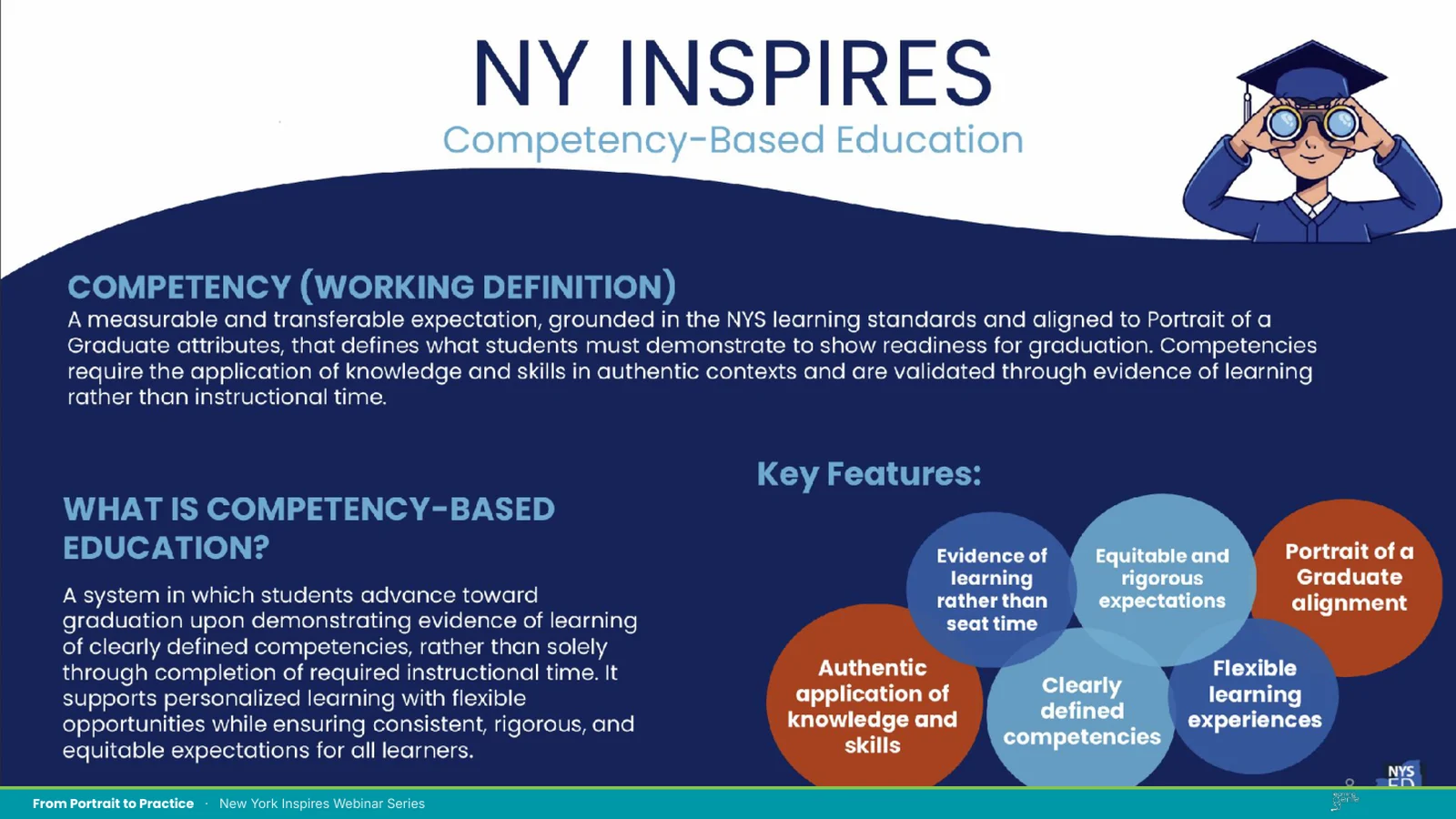
In the working definition shared in the session, a competency is “a measurable and transferable expectation, grounded in the NYS learning standards and aligned to Portrait of a Graduate attributes, that defines what students must demonstrate to show readiness for graduation.” Competency-based education is a system in which students advance toward graduation by demonstrating evidence of learning, rather than solely by completing required instructional time.
The key features are authentic application of knowledge and skills, clearly defined competencies, evidence of learning rather than seat time, equitable and rigorous expectations, flexible learning experiences and alignment to the Portrait of a Graduate.
How do you align Portrait of a Graduate attributes with your existing curriculum?
Start where strong curriculum design has always started. Angela Lalor walked through the familiar sequence: desired results, then assessments, then learning activities, held together by alignment. What changes under NY Inspires is the meaning of desired results. They now include the Portrait of a Graduate attributes alongside the content, process and metacognitive standards teachers already use.

Standards are not replaced; the attributes complement them. The Portrait of a Graduate becomes another lens for looking at the curriculum, so teachers are not asked to do more, only to be more strategic about how it is done. Attributes are the broad categories, such as Critical Thinker. Competencies describe what each attribute looks like at a given grade level and in a given discipline.
One example from the session: New York defines a critical thinker as a graduate who “analyzes information thoughtfully, evaluates evidence critically, and identifies patterns and connections.” That maps directly to the social studies practice of gathering, using and interpreting evidence. When the match is that close, the attribute fits into the unit naturally, and students start to see themselves as critical thinkers in social studies, science and beyond.
How many Portrait of a Graduate attributes should one unit include?
One or two. Trying to check every box stretches a unit thin and dilutes the evidence it produces. Choose the attributes you will actually teach and assess in that unit, and spread the six attributes across the year so students go deeper with each one.
Alignment also means transparency. Students should know which attribute they are working on, see what it looks like in the task, and reflect on their own growth. That reflection becomes formative evidence of learning.
How does Curriculum Genie build on a unit you already teach?
Most teachers have units they have refined for years. In Curriculum Genie, a teacher uploads an existing unit, even a one-page outline, and the platform extracts its desired results. The teacher confirms or edits each step, selects the standards and the one or two Portrait of a Graduate attributes to teach and assess, and can turn on localized curriculum when community examples will make the content more accessible.
The finished unit makes the attribute explicit for students. Short mini-masteries give students practice with the attribute and ask them to upload evidence and reflect on it. Performance-based assessments are aligned to the same attributes, so the evidence students produce in daily lessons builds toward the larger task. Teachers are not starting from scratch or adding more; they are building on proven units with a clearer focus. Throughout, the teacher is the author and makes every decision.
Start free in Curriculum Genie
How do districts build a local assessment system around the Portrait of a Graduate?
A local assessment system grows from the classroom up. Dr. Gene Shi described grade-level and subject-area teachers coordinating their performance-based assessments so that, across a year, students meet all six attributes more than once and teachers can see a progression instead of isolated scores.
Evidence includes more than the final product. Process data, such as discussion notes and how a team worked, is how students demonstrate collaboration and communication. AI can help teachers find that evidence against a rubric and suggest ratings, but the teacher remains the decision maker. One California high school Dr. Shi described asks each subject to run two performance-based assessments a year, which gives every student eight to ten chances to demonstrate the competencies.

What is the PoG Belt System for building teacher capacity?
NY Inspires is a gradual shift for some teachers and a full transformation for others. In the session, David Ross walked through Learning Genie’s PoG Belt System, a voluntary, progressive path from awareness to demonstrated practice, integration and leadership.
 White Belt
White Belt – Aware
Understands the foundations of PoG, performance-based assessment, and project-based learning.
 Yellow Belt
Yellow Belt – Applies
Knows PoG and PBA vocabulary. Implements curriculum-embedded PoG tasks with AI support alongside them.
 Green Belt
Green Belt – Integrates
Designs original tasks and rubrics without a template. Calibrates scoring reliably and leads independent project-based learning with students.
 Black Belt
Black Belt – Leads
Builds on Green Belt practice by coaching and leading other educators, strengthening consistent practice, and helping scale the work across schools or districts.
The Belt System is a professional growth pathway, not a teacher evaluation system. Belt progress is separate from APPR and is not submitted as part of any evaluation rating.
This webinar lived at the Yellow Belt: embedding one real performance task into a unit you already teach. The guiding phrase was “less, but real.” Coaching at the higher belts can come from instructional coaches, department chairs, teacher leaders or mentor teachers.
Explore the PoG Belt System overview
Where can I view the slides from this NY Inspires webinar?
Click through the full deck below, from the NY Inspires overview and the curriculum alignment process to the belt system and the Community of Practice. Use the arrows to move between slides, or open it full screen.
Want to go further? See how districts are moving from Portrait to Practice to Proof across New York.
Frequently Asked Questions
NY Inspires is the New York State Education Department's multi-year plan to transform teaching and graduation. It moves toward a single diploma, changes the Regents exams so they are no longer the graduation hurdle, adopts a statewide Portrait of a Graduate with six attributes, and opens multiple pathways for students to demonstrate learning.
A competency is a measurable and transferable expectation, grounded in the NYS learning standards and aligned to Portrait of a Graduate attributes, that defines what students must demonstrate to show readiness for graduation. It is validated through evidence of learning rather than instructional time.
One or two. Choose only the attributes you will actually teach and assess in that unit, make them visible to students, and spread the six attributes across the year so students go deeper with each one.
A local assessment system is a district's own way of gathering evidence that students have met the Portrait of a Graduate competencies. It is built from coordinated, curriculum-embedded performance-based assessments across subjects and grades, with teachers reviewing student evidence and progress over time.
A free community for New York educators, co-organized with the Western New York Educational Service Council, to turn the Portrait of a Graduate into local assessment together: learning from peers, building practical approaches, and starting wherever a district is, from exploring to scaling.
Bring the Portrait of a Graduate into the units you already teach
Upload an existing unit, choose the attributes to teach and assess, and build the performance task around it.