From Portrait to Practice: Building a Community-Owned Assessment System That Lasts
A Portrait of a Graduate only lasts when the community owns it. In this NY Inspires superintendent panel, Dr. Karen Cheser (Durango, Colorado), Dr. Rody Boonchouy (Winters, California) and Dr. Ray Sanchez (Tarrytown, New York) share how they moved their portraits from posters into daily teaching, built teacher capacity, and created a community-owned assessment system that can outlast any one leader.
More than 100 educators and district leaders joined Webinar 2 of the NY Inspires webinar series. Moderator Lisa Weber asked three superintendents who have led this work for years, in rural, small-town and suburban districts, what it really takes to make a Portrait of a Graduate part of how a district teaches, assesses and reports learning.
Who presented this NY Inspires superintendent panel?
 Lisa WeberModerator, Former Assistant Superintendent, New York
 Dr. Karen CheserSuperintendent, Durango School District 9-R, Colorado
 Dr. Rody BoonchouySuperintendent, Winters Joint Unified School District, California
 Dr. Ray SanchezSuperintendent, Public Schools of the Tarrytowns, New York
- Lisa Weber (moderator), New York district curriculum director and former Assistant Superintendent.
- Dr. Karen Cheser, Superintendent, Durango School District 9-R, Colorado. 2025 AASA/CoSN EmpowerED Digital Superintendent of the Year, former Superintendent of Fort Thomas Independent Schools and former national Vice-Chair of EdLeader21. Durango is her third district leading Portrait of a Graduate work.
- Dr. Rody Boonchouy, Superintendent, Winters Joint Unified School District, California. He led Winters' community-built Graduate Profile and spent 11 years at the Buck Institute for Education (PBLWorks), rising to Senior Director of Innovation and Strategic Partnerships.
- Dr. Ray Sanchez, Superintendent, Public Schools of the Tarrytowns, New York. 2025 New York State Superintendent of the Year, former Ossining UFSD superintendent.
How do you move a Portrait of a Graduate from the wall into the classroom?
Start by honoring the good work already happening. Both Dr. Sanchez and Dr. Boonchouy framed the portrait as a lens on existing practice, not one more initiative. In Tarrytown, the district adopted a Portrait of a Learner for PreK through grade 12 and crosswalked it with the New York State Portrait of a Graduate. Elementary schools spend months at a time on specific dispositions, such as curiosity, with a home connection for families. At the high school, some English courses became topic electives designed around the Portrait of a Learner, so the dispositions are more visible to students.
In Winters, every school lifted up a practice staff already owned and tied it to the graduate profile: play-based learning for collaboration and conflict resolution at the primary school, gallery walks that now show growth on profile skills at the intermediate school, and a long-running senior capstone that is now aligned to the same skills. What started the work was the data: decades of state results with almost no growth.
How do districts build community ownership of a Portrait of a Graduate?
Ownership, not buy-in, is what lets the work last. In Durango, Dr. Cheser's team engaged about 7,000 stakeholders: an industry think tank, every teacher and staff member, bus drivers and health staff, and students at lunch in all 11 schools, through about 30 community meetings and surveys. The district then wrote success criteria for each of its six competencies, with community members on the committees, so people could see their own input in the final portrait.
Communication has to be constant. Dr. Sanchez features Portrait of a Learner evidence in his weekly newsletter, in board presentations and in visits to senior citizen groups and Rotary, and staff now send him moments to celebrate, such as students showing perseverance.
How do superintendents give teachers time to do Portrait of a Graduate work?
Protect time and narrow the focus. Dr. Boonchouy counted 52 separate funding streams his district braids together, which can leave teachers feeling they must do everything at once. Winters gave schools permission to step back from other professional development and spend a full year defining what critical thinking or collaboration looks like at each site. Early release time now goes to one or two competencies, learning progressions and scoring calibration, and teachers report progress at every board meeting.
Durango made structural changes: early release every Monday, half of all professional development time set aside for teacher planning in the master agreement with the teachers union, shared units built around the competencies, and a paid group of teacher leaders who meet monthly to improve the tools. When teachers said the load was too heavy, the district cut the required success criteria from 24 per year to 8 per grade level.
What makes a community-owned assessment system sustainable?
Dr. Sanchez and Dr. Boonchouy both described the goal as a system that continues after the superintendent leaves. In Winters, the graduate profile now appears on elementary report cards, the district is building learning progressions this year that define proficiency from kindergarten to grade 12, and an AI-enabled learning management system assesses profile skills at the secondary level. Dr. Boonchouy sees the long-term goal as culture: families and new teachers simply expect this kind of teaching and learning.
Tarrytown is developing performance-based assessments after staff visited New York consortium schools, with grade-level teams building assessments aligned to the portrait. Its Change Makers program, a summer women's leadership pilot with neighboring districts and a partnership with Manhattanville University, ends with students presenting the change they are leading. The district now sees it as a model for other content areas.
Durango assesses both academics and competencies. Students apply the competencies inside their regular coursework, reflect on them, and upload evidence that teachers, principals and parents can see. Capstone presentations in grades 2, 5, 8 and 11 are open to the public, include feedback from peers, teachers and industry partners, and are a graduation requirement. Dr. Cheser reported that Durango has moved from the bottom 30% of districts in Colorado to the top 10%, the only rural district to do so.
Do Portrait of a Graduate competencies apply to students with IEPs and multilingual learners?
Yes. In Durango, every student takes part, including students with a 504 plan, an IEP or an alternate diploma, and the competencies appear in IEP goals. Dr. Sanchez stressed that a Portrait of a Learner is for all learners. Dr. Boonchouy has seen multilingual learners speak up with more confidence, because every student brings assets such as leadership, deep thinking, conflict resolution and communication, which moves classrooms away from a deficit view.
What advice do these superintendents give New York districts?
- Don't do this alone: borrow, adapt and share what works across districts.
- Align everything: strategic plan, curriculum, recognitions, showcases and industry partnerships should all point to the portrait.
- Model it as adults: Durango holds its leaders to the same competencies it asks of students.
- Lift student voice: Winters created a junior board of students who help shape decisions.
What challenges do districts face in building a Portrait of a Graduate assessment system?
Across Colorado, California and New York, the panel kept returning to the same six obstacles. Each one points to something a district system has to make easier for teachers, not harder.
Dr. Boonchouy met early pushback in Winters until the work was framed as lifting up practices teachers already owned.
Teachers bring the lessons they already teach, and Curriculum Genie shows where Portrait of a Graduate competencies already fit, so the work builds on current practice.
Dr. Cheser listed standards, technology tools, career interests and competency success criteria all landing on the same teachers.
AI-assisted planning turns an existing lesson into a 5 to 7 minute Mini-Mastery activity or a standards-aligned performance-based assessment that grade-level teams can plan together.
Durango cut required success criteria from 24 a year to 8 per grade level and pushed for a tool with fewer clicks.
Grade-level teams map which competencies each subject covers, so no teacher has to assess every attribute in every unit.
Winters spent a full year defining each competency at every school and is now building K-12 learning progressions to calibrate against.
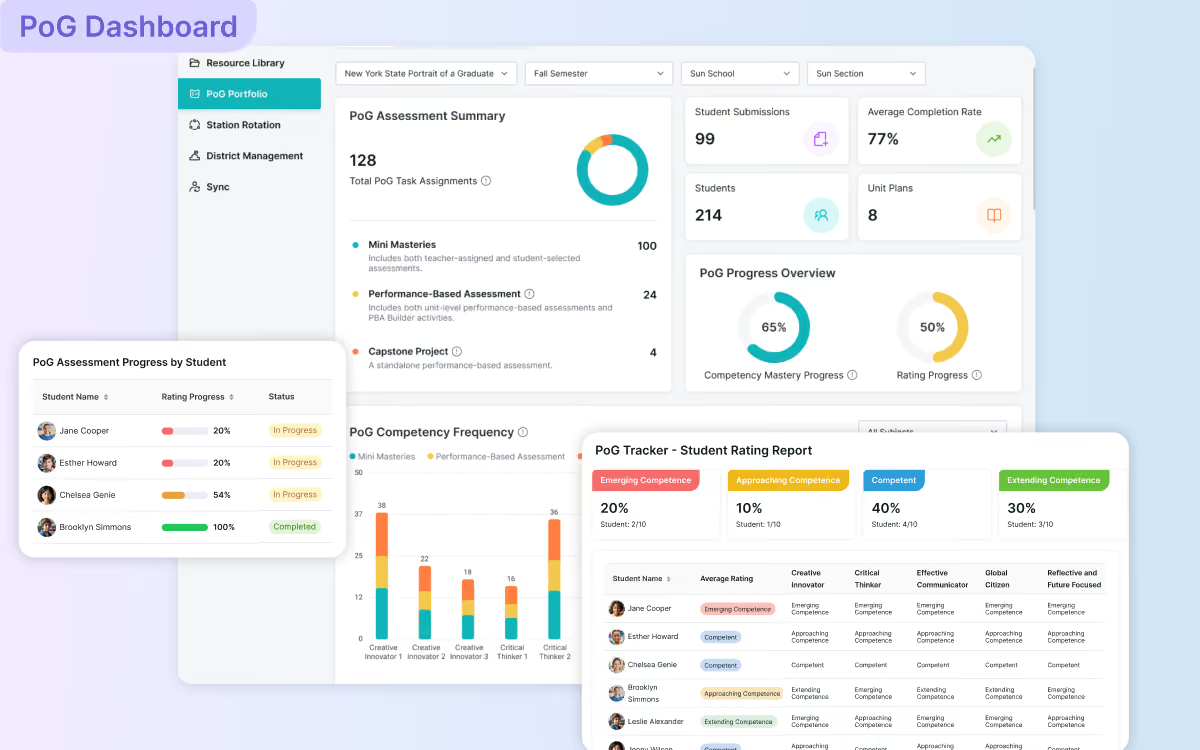
Rubrics aligned to the six NYS Portrait of a Graduate attributes rate evidence from Emerging to Extending. AI suggests ratings, and teachers review and finalize every one.
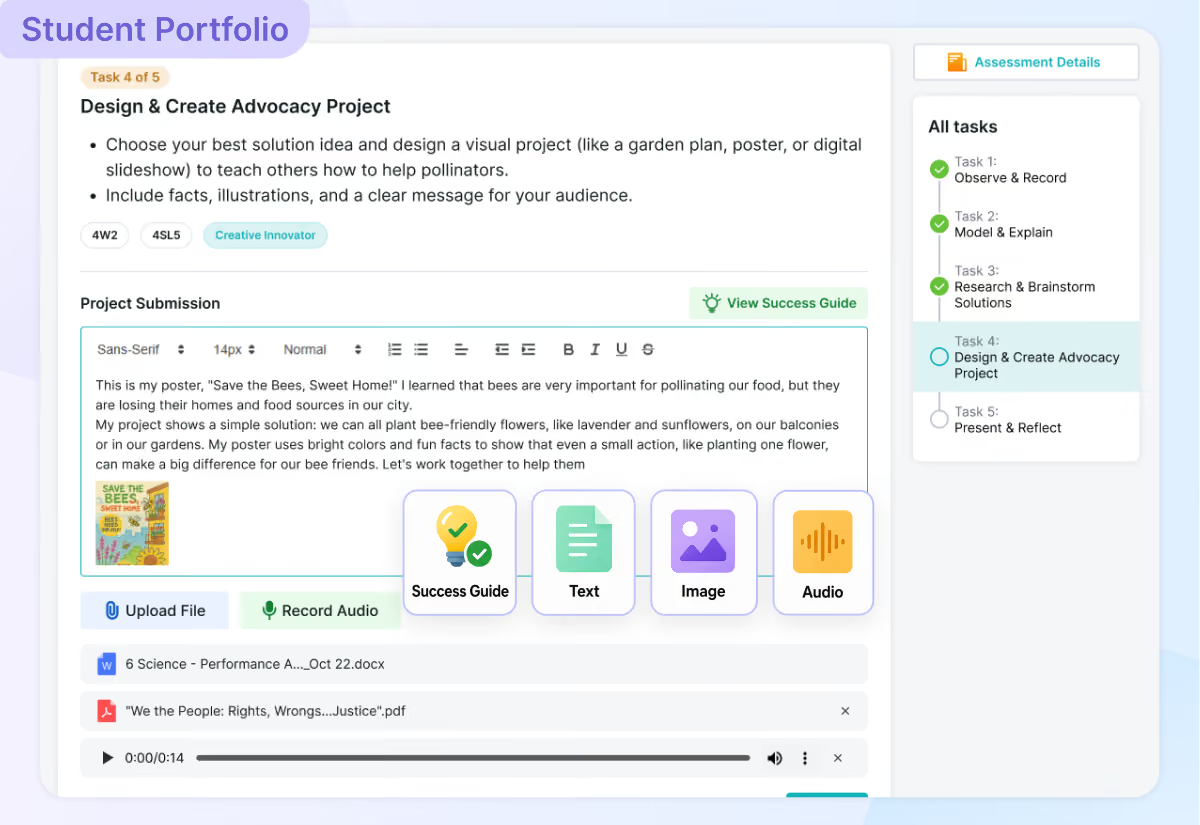
In Durango, students upload evidence that teachers, principals and families can all review.
Students submit text, images, audio or files linked to the lesson, standards and competency, and leaders follow progress on a Portrait of a Graduate dashboard.
Early in his career, Dr. Boonchouy saw similar schools lose momentum as founding staff turned over.
Units, tasks and evidence live in one district system, and the PoG Belt System grows teacher leaders from Aware to Leads.
How does Curriculum Genie support a community-owned assessment system?
The superintendents built ownership through community engagement and leadership, and no tool replaces that. Curriculum Genie supports the classroom side: it helps teachers embed Portrait of a Graduate competencies in the units they already teach, collect student evidence, and give leaders a clear view of growth.

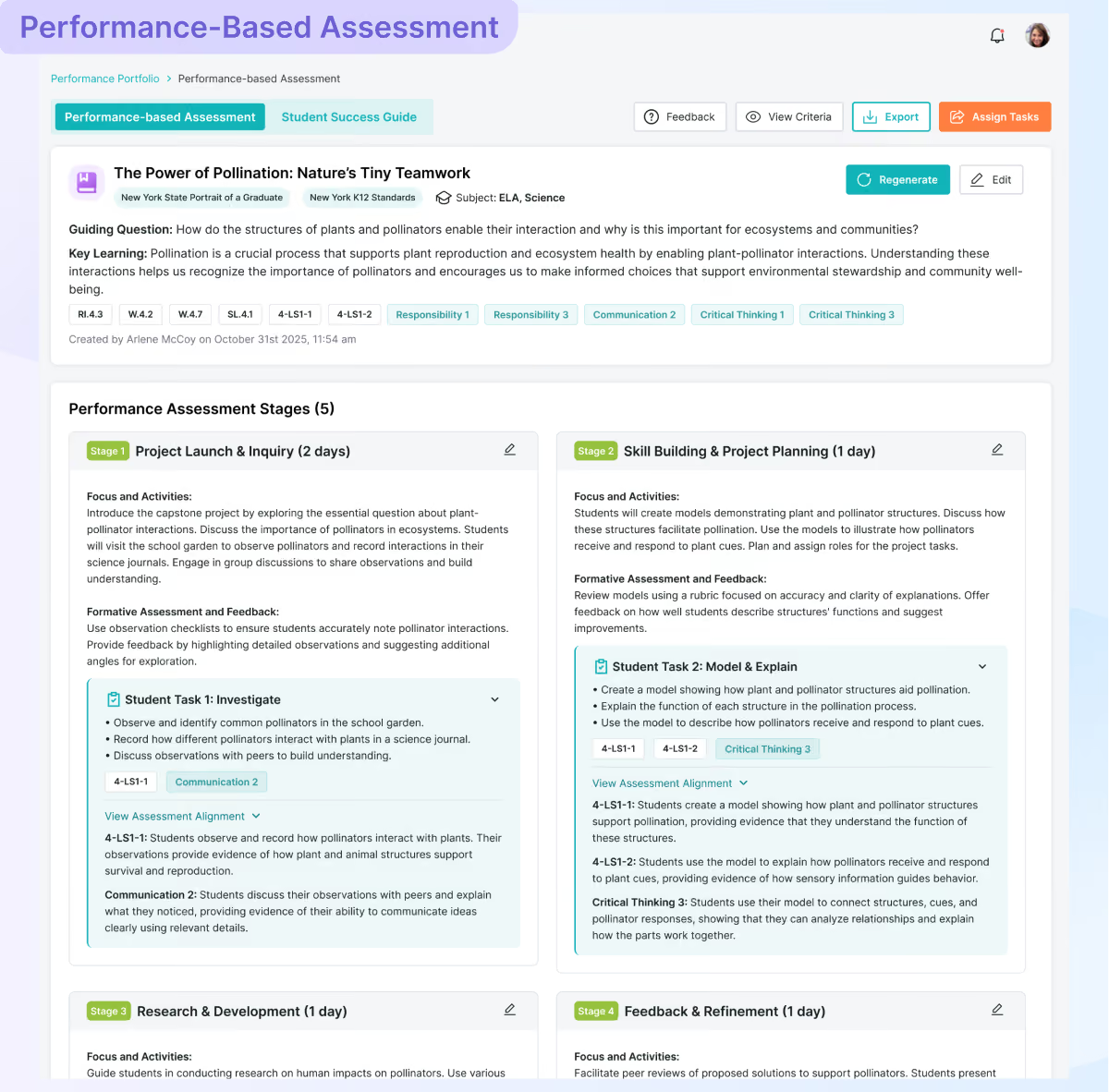
Curriculum Genie is validated at ESSA Evidence Tier 3 in a Johns Hopkins University study, and Learning Genie is New York Education Law 2-d compliant. Student data is not used to train AI models. See how the pieces fit together in the district local assessment model.
For the classroom side of this work, watch Webinar 1, From Portrait to Practice: Build on What Already Works in Your Classroom.
Frequently Asked Questions
A local assessment system for Portrait of a Graduate competencies that educators, families, students and community members help define and understand. It combines classroom evidence, performance-based assessments, capstones and reporting so it can last beyond any one leader.
Engage every group early, including teachers, staff, students, families and local employers, then show people their input in the final portrait and success criteria. Keep communicating evidence of the portrait in newsletters, board meetings and community events.
Protect collaboration time, such as weekly early release, narrow the focus to one or two competencies at a time, share common units, and listen to teachers. Durango cut its required success criteria from 24 per year to 8 per grade level after teacher feedback.
Through performance on real coursework rather than checklists alone: rubrics, student reflections, learning progressions, report cards and public capstone presentations with feedback from teachers, peers and community partners.
Yes. The panel districts include every student. In Durango, students with IEPs, 504 plans and alternate diplomas take part, and the competencies appear in IEP goals.
Turn your Portrait of a Graduate into classroom evidence
Curriculum Genie helps teachers build Portrait of a Graduate attributes and performance-based assessments into the units they already teach.