The AI Engagement Engine: From Passive Learning to Real-Time Instruction
The biggest hurdle in student achievement isn't a lack of effort—it's feedback latency.
When days pass before a teacher realizes a class misunderstood a key concept, the curriculum has already moved forward. The result? Wasted instructional time and disengaged learners.
Closing that distance is what the ACSA Partner4Purpose webinar “The AI Engagement Engine: Rapid-Fire Strategies to Solve the Student Engagement Crisis Using AI” set out to address. Presented in partnership with Learning Genie, the session brought together Jon Corippo, co-creator of EduProtocols; Jerry Almendarez, former Superintendent of Santa Ana Unified; and Dr. Lala Zhang, Co-founder of Learning Genie.
The opportunity in AI is not replacing teachers or generating more content. It is collapsing the interval between learning and response.
The Problem Isn’t Screen Time. It’s Passive Learning.
When students disengage, the devices get blamed. But a student copying notes off a whiteboard is looking at a screen of a different construction. A student waiting for their name to come out of a cup is not engaged; they are queued. And a class working silently through an eleven-page packet is the most passive arrangement in the building, with the added cost that one teacher now holds several hundred pages to mark by hand.
Swap the screen for paper and the format changes. The student’s role does not.
Two conditions separate a classroom where students are working from one where they are complying. Active production: students make something rather than receive something. Visible accountability: they can see how they did, in terms they understand, because a stamp is approval rather than information. Add a third and you have the whole model: the response arrives while the learning is still live.
Every parent of a child in a competitive sports program already accepts this without argument. Practice is active work with immediate correction. Nobody tolerates a coach who watches in silence and mails notes the following Thursday.
The most important question is not, “Are students using technology?” It is, “What are students being asked to do with it?”
Engagement shows up in what students actually do: investigating their own questions, explaining how they reached an answer, comparing their approach against a classmate’s, choosing how to demonstrate what they know, and revising after feedback instead of filing it away. That is agency-based learning, and the CAST Universal Design for Learning Guidelines name the same elements: choice, autonomy, relevance, authenticity. For classroom strategies at the secondary level, see boosting student agency in middle and high school.
What Should AI Actually Do in a Classroom?
It can entrench passive learning or help dismantle it.
An AI tool that only produces more worksheets, summaries, and generic assignments has accelerated the wrong thing. The volume of output grows. The student experience does not.
A stronger use connects standards to real objectives, turns passive tasks into active ones, differentiates for learner variability, ties content to local context, and, most importantly, produces assessments aligned to what was actually taught, surfacing misconceptions before the class moves on.
Judgment stays with the teacher. Whether a learning experience is accurate, appropriate, equitable, and right for these particular students is not a question a system answers. AI can organize the instructional process. Educators supply the relationships, context, and judgment that make it mean anything.
How Curriculum Genie Embeds EduProtocols
EduProtocols are reusable instructional frameworks for structuring active learning across subjects and grade levels. Because the structure repeats, teachers are not inventing an activity every lesson, and students spend less time decoding directions and more time on the content.
But a framework only changes practice if a teacher can reach it while planning. A protocol described in a book competes with everything else on the desk. A protocol built into the planning workflow does not.
Curriculum Genie is an agentic AI curriculum platform, and EduProtocols live inside its planning surface. The template library sits alongside the unit a teacher is already building, so a protocol attaches to a specific lesson rather than arriving as a separate initiative.

The library includes BookaKucha, the Frayer Model, Sketch and Tell, Thin Slide, Thick Slide, and Cyber Sandwich. A teacher can attach one to a standards-aligned lesson with the objectives, materials, and implementation steps already in place. Three things change when the protocol and the curriculum share a system:
- The protocol arrives with the lesson. No one has to translate a framework from one resource into a plan built somewhere else.
- Formative activities are generated from the unit. Questions come from the unit’s own content, standards, and intended level of thinking rather than an unrelated source.
- The results return to the same place. Response data appears where the unit lives, so what students demonstrated can shape the next lesson directly.
From Delayed Grading to Real-Time Feedback
Fast & Curious, the protocol demonstrated in the session, is retrieval practice on a deliberately short cycle: quiz, play, coach, repeat.
The activity was generated from an existing two-week, sixth-grade unit, carrying that unit’s content, standards, and intended level of thinking. Participants joined and played live. Results arrived as they answered, and the questions with the highest error rates surfaced on their own.
Then the teacher coaches two questions. Not eleven.
That restraint matters more than the speed. Corippo has described the failure mode of his own early teaching: giving feedback on everything, which overwhelmed the students with the furthest to go and bored the ones already there. Narrowing to the two concepts that actually broke is not a shortcut. It is what makes the correction land for the students who need it.
- Students take a first pass, cold.
- Results arrive live, while the class is still together.
- The highest-error questions surface on their own.
- The teacher coaches those concepts rather than the whole set.
- Students play again, and mastery builds across repetitions.
The value was not faster grading. It was faster instructional response.
Formative assessment is meant to shape instruction while it is still happening. A U.S. Department of Education–funded formative assessment guide describes it as identifying strengths and misconceptions, adjusting instruction, and giving feedback as learning unfolds. Set the two cycles side by side and the difference is structural:
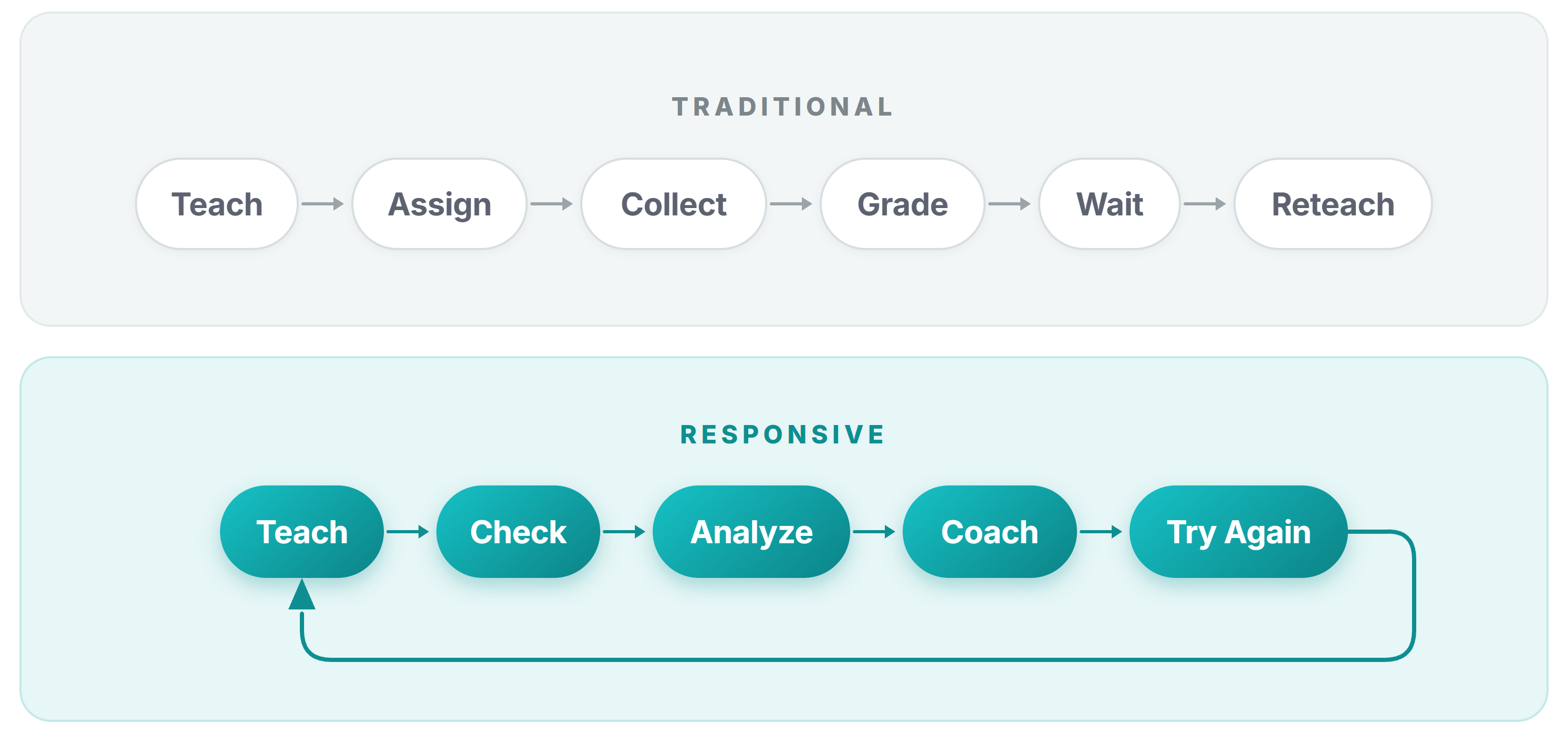
One cycle ends in a grade. The other ends in another attempt.
Why Must Assessment Come From the Curriculum?
Speed alone is not enough. An assessment is only useful if it measures what students were meant to learn.
Pull one from a marketplace download or an inherited file and it will be approximately on topic and not aligned to this week. A score from a misaligned instrument cannot be read: the student may have missed the item because the concept never landed, or because it tested something the unit never covered. In the data, those look identical. Decisions made on that basis are estimates wearing the appearance of evidence.
In the demonstration, the questions came from the unit itself. That is the whole difference.
Curriculum Genie holds standards-aligned units, differentiated resources, student activities, formative assessments, and teaching materials in one system. The same principle applies whether you are building a new unit with AI, differentiating through station rotation, or using Adapt Existing Unit to strengthen curriculum you already teach, following the step-by-step guide.
What Does This Mean for District Leaders?
Districts do not lack data. They lack signal: something that says what is happening and what should happen next.
A signal is a concept most of a class missed, a standard not appearing consistently across units, or a gap between a stated district priority and what is actually being assigned. Signals that once took months can now take days, and the accountability calendar has moved with them. That is not an argument for another dashboard. Most districts have a surplus. It is an argument for shortening the distance between a classroom event and someone able to act on it.
Which changes the evaluation question. Less about how much a tool can generate, more about these:
- Does it strengthen curriculum and assessment alignment?
- Can teachers review and customize the output, or is it locked?
- Does it support multilingual learners and students with disabilities?
- Does it protect student data, and where does that data go?
- Does it produce evidence leaders can actually see?
- Does it preserve teacher judgment and human oversight?
The California Department of Education’s guidance on artificial intelligence in public schools emphasizes the same priorities: responsible implementation, equity, safety, and continued human oversight.
This is the same work as turning district vision into classroom practice, whether through a Portrait of a Graduate or by embedding those commitments in curriculum and portfolios. Learning Genie’s related analysis for school leaders is on ACSA’s Resource Hub in Measuring What Matters: Assessment in an Age of Agency and AI.
Better Technology Is Not the Goal
Curriculum Genie is not an AI lesson generator with features attached. It is an agentic AI curriculum platform built around a loop — plan, engage, assess, understand, coach, improve — in which each step feeds the next instead of ending in a folder. Teachers make every decision inside that loop. The platform makes the process visible.
The future of AI in education will not be measured by how much content a system produces. It will be measured by whether students are thinking, creating, collaborating, reflecting, and improving.
Technology is not the engagement strategy. Strong instructional design is.
Try Curriculum Genie for free and see how curriculum, EduProtocols, and formative assessment work as one system.
Frequently Asked Questions
How can AI improve student engagement?
Curriculum Genie can help teachers design differentiated pathways, collaborative activities, real-world connections, formative assessments, and opportunities for student choice and reflection.
What are EduProtocols?
EduProtocols are reusable instructional frameworks that help teachers structure active, student-centered learning across subjects and grade levels.
What is the Fast & Curious EduProtocol?
Fast & Curious is a retrieval practice routine built on a short cycle: quiz, play, coach, repeat. Students answer rapid questions, the teacher uses real-time results to identify misconceptions and deliver targeted instruction, and the round repeats so retention and mastery build.
How does AI support formative assessment?
Curriculum Genie can help generate curriculum-aligned questions, organize response data, identify common misconceptions, and provide teachers with faster visibility into student understanding.
Does AI replace the teacher?
No. Teachers remain responsible for reviewing content, interpreting student responses, understanding context, and making final instructional decisions.
What should district leaders consider when evaluating AI?
District leaders should examine curriculum alignment, customization, learner supports, privacy, instructional evidence, human oversight, and alignment with district priorities.