Boosting Student Agency in Middle and High School: Practical Strategies and the Role of AI Co-Creation Tools

Introduction
Student agency — the ability for learners to have control over their learning, motivation, and actions — is foundational to deeper engagement, self-regulation, and lifelong learning. Research consistently links student agency with higher resilience, adaptability, and motivation. Classrooms that center student voice and choice empower learners to become active participants in their education.
In today's evolving landscape, artificial intelligence (AI) offers powerful new ways to deepen student agency. In particular, AI co-creation tools like Curriculum Genie and its AI Curriculum Agent can transform the student-teacher partnership, supporting ideation, co-construction, and continuous adaptation of learning experiences. This paper outlines practical, research-backed strategies to foster student agency and explores how AI can enhance these efforts.
Student and Teacher Co-Creation
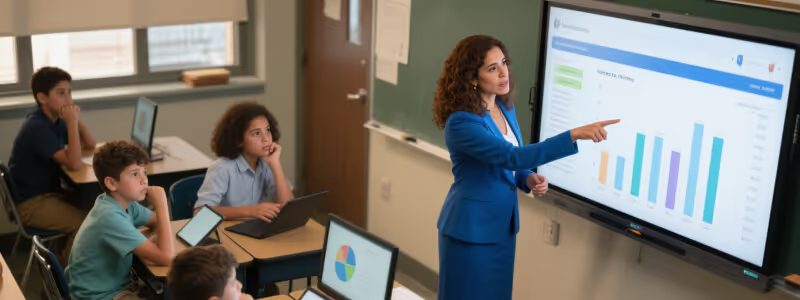
Co-creating learning experiences with students is a core strategy to boost agency. Instead of receiving a top-down curriculum, students collaborate with teachers to design norms, learning pathways, assessments, and projects.
Strategies:
- Co-create classroom norms and learning goals.
- Develop rubrics and project criteria together.
- Allow students to co-design inquiry questions, project topics, and learning experiences.
Example:
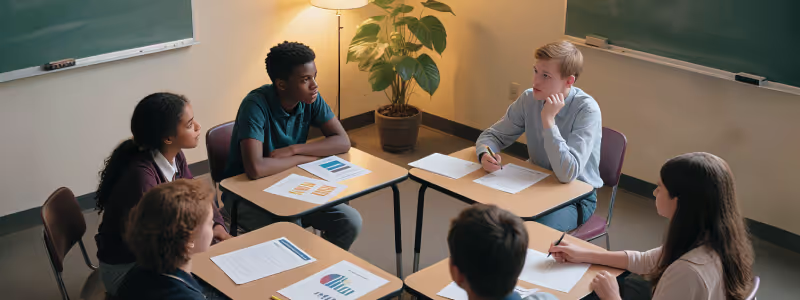
In one English class, students brainstormed big questions they wanted to explore around identity and culture. Together, they mapped out a thematic unit that included novel choices, multimedia projects, and peer-reviewed presentations.
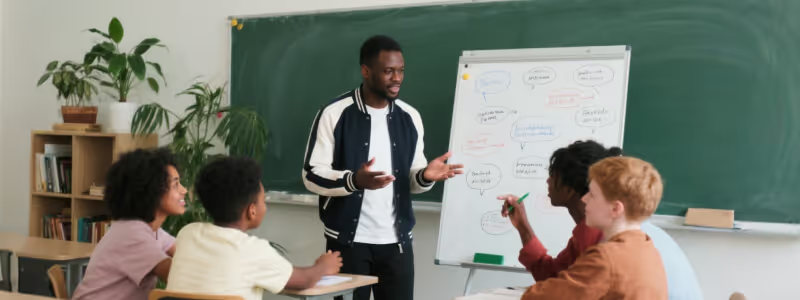
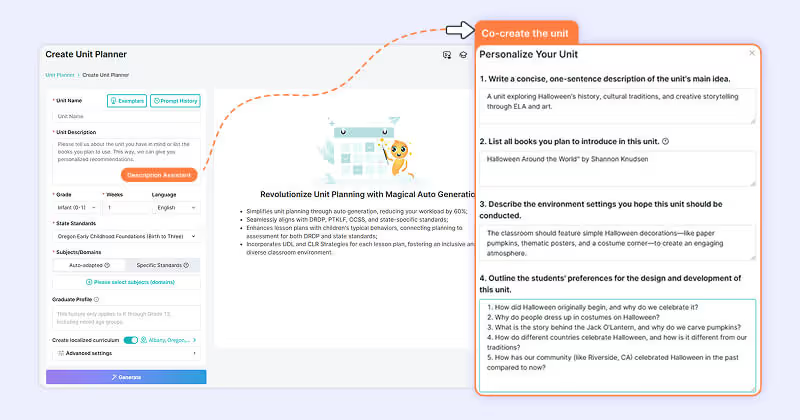
Enhancing Co-Creation with AI: Tools like Curriculum Genie's AI Curriculum Agent take co-creation even further. At the beginning of a unit, students and teachers collaboratively brainstorm ideas and questions, feeding them into the AI system. The AI then follows these co-created ideas, helping organize them into tailored units that reflect students' interests, curiosity, and authentic inquiry. This preserves student voice while supporting teachers in designing responsive and standards-aligned curriculum.
Voice and Choice: Flexible Learning Options
Student agency grows when learners have meaningful choices in how they engage with material and demonstrate mastery.
Strategies:
- Offer choice boards and menus for assignments.
- Provide options in content, process, and product.
- Encourage creative demonstrations of learning (videos, podcasts, artistic pieces, etc.).
Example:
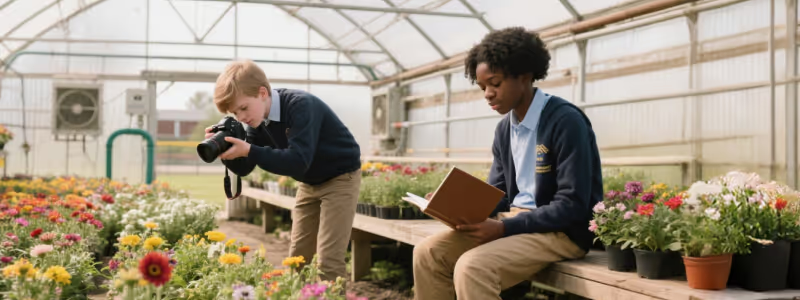
In a science unit on ecosystems, students chose whether to create an informational podcast, build a diorama, or write an editorial article advocating for environmental protection.
Project-Based Learning (PBL) and Authentic Problem Solving
Project-Based Learning offers a natural framework for student agency by making students the drivers of inquiry, research, problem-solving, and presentation.
Strategies:
- Center projects around real-world challenges.
- Give students voice in defining sub-topics, team roles, and final products.
- Facilitate regular reflection and revision.
Example:
High schoolers developed public service campaigns to address mental health stigma among youth, choosing formats (videos, social media ads, murals) and presentation venues (school assemblies, community centers).
AI-Supported Continuous Adaptation
Using Curriculum Genie, students and teachers can review the evolving progress of a project. The AI agent supports reflection, pivots, and adaptations based on ongoing learning. If students encounter new questions or shifts in interest, the AI tool helps reorganize units and suggest new directions. This continuous cycle of co-creation, adaptation, and personalization fosters a truly agentic learning environment.
Personalized Goal-Setting and Reflection
When students set their own goals and track their growth, they internalize responsibility for learning.
Strategies:
- Teach SMART goal setting.
- Build in weekly reflection and goal review time.
- Use goal notebooks, portfolios, or digital trackers.
Example:
Students maintained digital growth charts, updating them after assessments and setting micro-goals for improvement. Teachers used these as part of conferences and self-assessments.

Student-Led Conferences and Student Voice in Assessment
Student-led conferences give learners the opportunity to take ownership of their achievements and learning needs.
Strategies:
- Coach students to present evidence of growth.
- Use structured templates for reflection and goal-sharing.
Example:
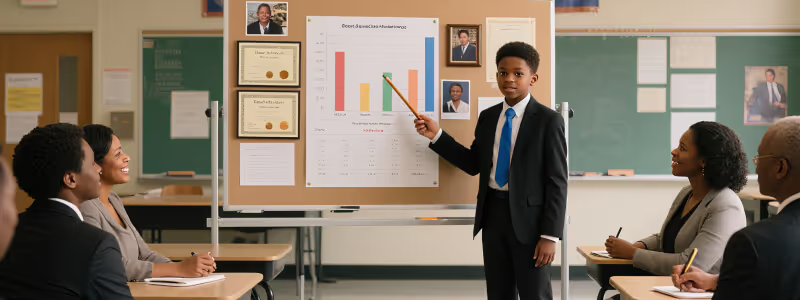
During spring conferences, eighth graders led discussions with parents and teachers, highlighting academic work they were proud of and outlining goals for high school transition.
Leadership Roles and Peer Mentoring
Assigning leadership roles within the classroom and creating peer mentoring systems extends agency beyond academic tasks.
Strategies:
- Rotate academic and operational leadership jobs.
- Create peer tutoring and cross-age mentoring programs.
- Encourage student-run clubs and initiatives.
Example:
11th graders mentored 9th graders in study skills, reducing transition anxiety and reinforcing leadership among upperclassmen.

Building New AI Literacy Through Co-Creation and Adaptation
Working with AI tools like Curriculum Genie to support curriculum co-creation, adaptation, and reflection builds an important new AI literacy for both students and teachers:
- Understanding AI as a collaborative tool: Students experience AI not as a "replacement" for thinking, but as a partner that follows and amplifies human ideas.
- Practicing continuous learning and iteration: The AI's ability to reorganize and pivot models a growth mindset and teaches that learning is dynamic, not static.
- Developing critical thinking about technology: Students engage critically with AI-generated outputs, evaluating how well the AI interprets their ideas and suggesting improvements.
This emerging AI literacy — centered on collaboration, iteration, and reflection — equips students with future-ready skills for a world increasingly shaped by intelligent technologies.
Conclusion: Toward a Dynamic, Agentic Classroom Culture
Empowering student agency requires strategic shifts — in mindset, classroom structures, and tools. By combining research-backed practices like co-creation, choice, project-based learning, goal-setting, and leadership opportunities with the intelligent support of AI co-creation tools like Curriculum Genie, educators can foster classrooms where students are active agents of their own learning journeys.
The future of education lies not only in delivering content, but in empowering students to shape, adapt, and lead their own learning with curiosity, creativity, and confidence — alongside both human and AI collaborators.
Frequently Asked Questions (FAQs)
Q: How can teachers offer meaningful student choice without turning every student’s learning into a completely different plan?
A: Choice does not have to mean designing a separate curriculum for every student. Teachers can offer structured options in content, process, or final products—for example, letting students choose a project topic or how they demonstrate learning—while keeping everyone within a shared set of learning goals and expectations.
Q: How can teachers tell whether students are actually developing greater ownership of their learning?
A: Teachers can look for evidence that students are taking a more active role in setting goals, reflecting on progress, revising their work, and explaining their own growth. Goal reviews, portfolios or digital trackers, reflection, and student-led conferences can make that ownership more visible over time.
Q: How can AI support student agency without replacing student thinking or decision-making?
A: AI can help organize and develop student ideas without becoming the source of those ideas. For example, students and teachers can brainstorm questions, interests, or project directions together, and educators can bring those ideas into Curriculum Genie to help organize them into a unit. Teachers and students can then review and refine the result, keeping human judgment and decision-making at the center of the process.
Q: What about students who do not want more choice, or who make choices that do not serve them well?
A: Student agency does not require giving every student unlimited choice. Teachers can provide a smaller set of meaningful options, model how to make productive learning decisions, and offer more guidance when students need it. The goal is to build students’ capacity to make thoughtful choices over time, not to remove teacher structure or support.