
CTE Curriculum Development: How to Turn Industry Expertise Into Standards-Aligned Units

Ask a welder what a good weld looks like and you get an answer in seconds. Ask the same welder to turn one state standard into two weeks of lessons, a performance task and a rubric, and the answer takes a lot longer. One teacher in the Vibe Design Academy said developing five lesson plans takes up every Sunday.
That gap between knowing the work and designing the learning is what the free Vibe Design Academy set out to close. Across three sessions in fall 2026, Dr. Matt Rhoads, Ed.D., a San Diego State University lecturer and author of ten books on instruction, walked CTE teachers through one method they can reuse on any standard in any pathway. This guide brings that CTE curriculum development method together in one place, with the worked example he used throughout, so you can run it on your own standard this week.
CTE curriculum development, in three steps: (1) turn one standard into a competency students can visibly perform; (2) design an authentic performance task and a rubric where Proficient equals that competency; (3) build the unit backward from the task, then verify every lesson before students see it. Curriculum Genie, by Learning Genie, drafts the unit from your competency, task and rubric. You stay the expert who checks and approves it.
What makes CTE curriculum development different?
CTE curriculum starts from real work, not from a textbook. A strong unit prepares students to do something a professional would recognize: a weld that passes inspection, a care plan a nurse would accept, a lighting pass an art lead would approve.
Standards describe that work in school language, compressed into a single sentence by committees of agencies, employers, unions and guilds. The teacher's industry experience is what turns that sentence back into work students can do. The timing makes this skill more valuable: Advance CTE released the modernized National Career Clusters Framework in October 2024, with 14 Career Clusters and 72 Sub-Clusters, and states are realigning their CTE standards to it, many in phases. A repeatable method means every new standard is a starting point, not a rebuild.
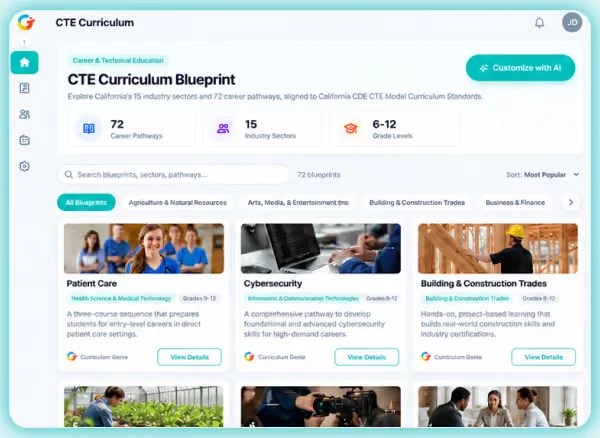
In Curriculum Genie, CTE curriculum starts from Blueprints aligned to your state's CTE standards, organized by industry sector and pathway:
Step 1: How do you turn a CTE standard into a competency?
Write one sentence that names what a student will do, with what, to what standard and for whom. Dr. Rhoads gets there in four moves.
- Break it down. Underline the verbs (what students do) and box the nouns (what they must know). Then test every verb: could you watch a student do it from across the room? "Differentiate" passes. "Apply" passes only once you name the evidence.
- Translate it. Run the standard through four lenses it rarely spells out: the tools, the conditions (a brief, a deadline, alone or in a team), the quality expectations, and the professional context, meaning who reviews or uses the work.
- Write the competency. Given [tools and conditions], the student will [observable performance] to [quality expectation], as [professional context] requires.
- Say why it matters. Write one line a 16-year-old would believe and an industry professional would sign off on.
The worked example was California CTE standard AV.17.1 (Animation and Visual Effects): one sentence, three verbs and about nine things to teach. The competency: given a modeled scene, a written mood brief and a 3D package, the student will light and color-grade the scene so it reads as a stated time of day and mood without a caption, as a lighting artist delivering for art-lead review requires. The why-it-matters line: every shot you have ever watched was lit on purpose.
Session 1, Turn One CTE Standard Into Career-Ready Performance, walks through all four moves, and Station Card 01 puts them on one page.
Step 2: How do you design an authentic CTE performance task and rubric?
Design the task a working professional would recognize, then write a rubric where Proficient is the competency. An authentic task passes four tests:
- A real deliverable: something a professional hands over, not a worksheet.
- A real audience: someone who approves the work or sends it back.
- Real constraints: the industry's tools, conditions and a deadline.
- A real judgment call: more than one good answer, defended with evidence.
GRASPS, the task frame from Wiggins and McTighe's Understanding by Design (Goal, Role, Audience, Situation, Product, Standards), turns the competency into a task almost directly: tools and conditions become the Situation, the professional context becomes the Role and Audience, and the quality bar becomes the Standards. Then add one complication that forces a decision. In welding: the fit-up is off by 1/16 inch and the inspector arrives at 2:00.
For AV.17.1, the task became Dailies: Three Shots, One Mood: a junior lighting artist lights one scene across three cameras for the art lead at dailies. The rubric has four rows (reads without a caption, light and shade, consistency across shots, professional delivery and revision) and four levels: Not Yet, Developing, Proficient and Industry-Ready. At Proficient, three cold readers can name the intended time of day and mood. At Industry-Ready, they can also point to the visual evidence.
Session 2, Build a Career-Ready CTE Unit You Can Actually Teach, builds this task and rubric step by step.
Step 3: How do you build and verify a CTE unit with AI?
Put the task in first, let AI draft the unit, then verify every lesson as the industry expert. In a new Curriculum Genie unit, the unit description is the steering wheel: paste the competency, one sentence on why it matters, the task with its twist and the rubric rows, plus the instruction to build every lesson toward the task. Select your state's CTE standard and start small, with one standard and a two-week unit.
Here is the two-week unit Curriculum Genie drafted for AV.17.1, with weekly planning, concepts and guiding questions:

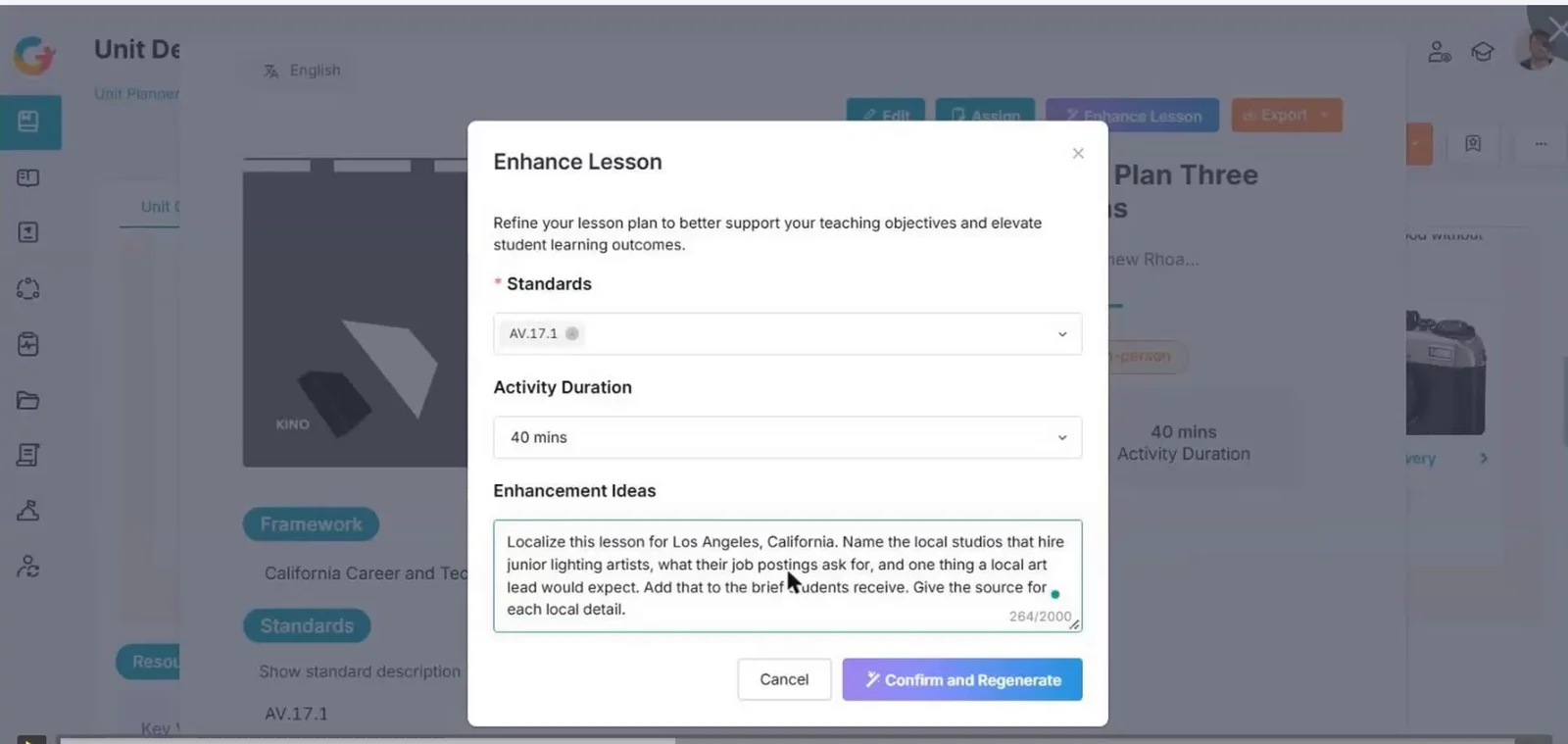
In the session demo, AV.17.1 became ten lessons: a Learn It week and a Do the Task week. Each lesson came with objectives, teacher slides, a reading passage, a quiz with Depth of Knowledge levels and an answer key, EduProtocols activities and UDL supports. Curriculum Genie can also localize a unit to the industries and employers near your school, and it lists the sources it drew on so you can open each one.
To localize or revise a lesson, Enhance Lesson takes the standard, the activity length and your own direction, including the local studios or employers and the sources you want it to use:
Then the expert review. Session 3, Teach It, Verify It, Improve It, gives a routine for it:
- Set, Source, Show. Set the local area, open one source for each local claim (a job posting, a licensing board, your advisory board's notes), and record what changes in the task.
- Mark every lesson I, W or Y (I do, we do, you do), and put a we-do lesson right before the first lesson students do alone. In a lab or shop, that sequence is a safety plan as much as an instructional one.
- Ask four questions of every lesson: Is it technically accurate for an industry professional? Does it respect safety protocols, codes and specs? Does it still assess the standard it claims? Did it simplify the content, or the thinking?
- Keep a verification record: standard, student performance, evidence, criterion and finding, with anything unresolved on hold until it is checked.
Here is one lesson from that unit, Light Source Lab, with its framework, standard and objectives ready for that review:
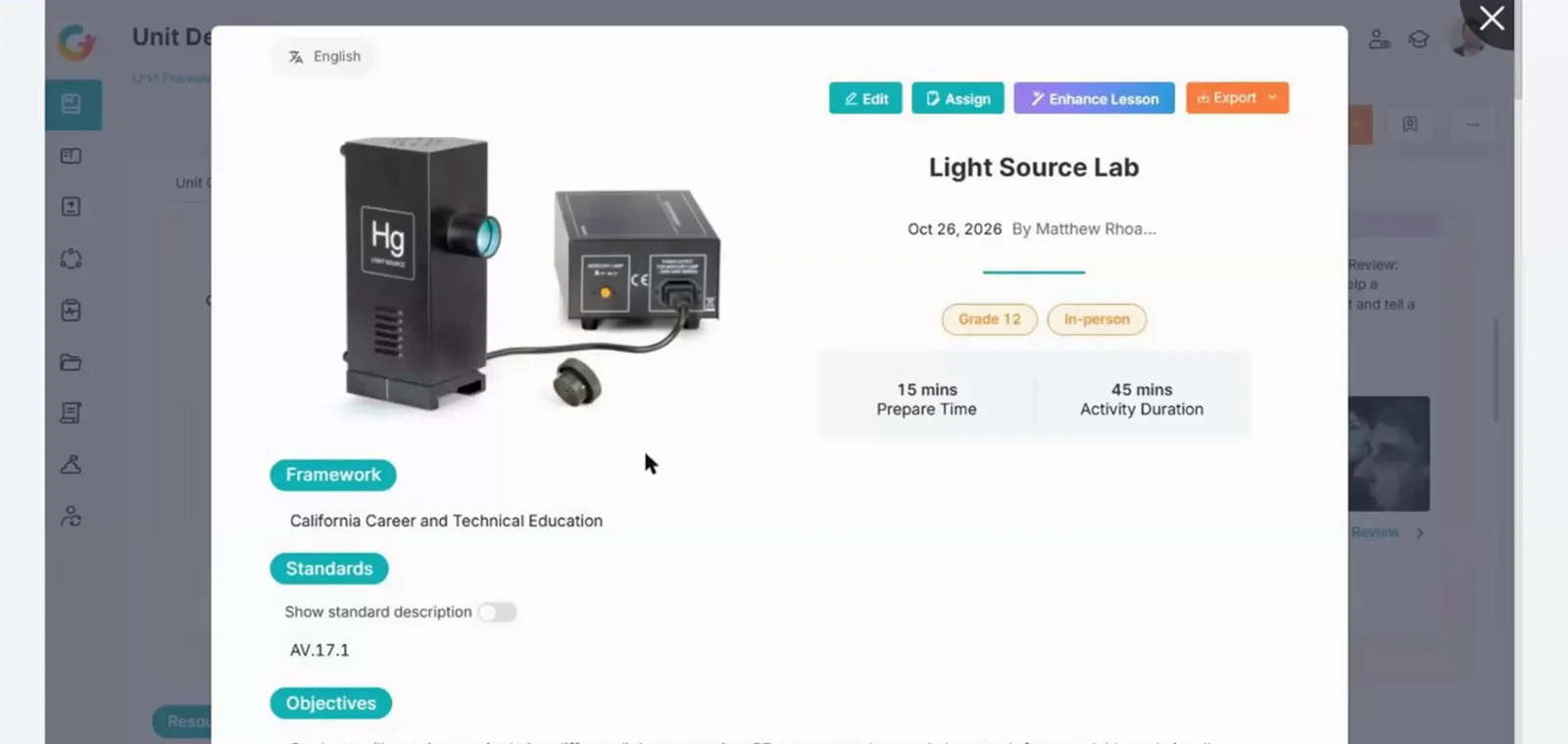
A generated unit is a strong first draft. Plan two or three rounds of review, and start with the numbers and the safety steps.
What do CTE leaders look for in curriculum?
Connection to local workforce needs, evidence of student outcomes, and standards alignment, in that order. A 2026 MMS Education survey of 50 K-12 CTE decision makers, presented at ACTE's Best Practices for CTE Administrators conference, found that 77% call CTE a high or very high priority. When judging a curriculum partner, 64% rated connection to local workforce needs very important, 57% evidence of student outcomes and 49% alignment to state standards and approved pathways. Looking ahead, 87% expect investment in work-based learning and employer partnerships to grow, and a clear implementation plan and timeline was the top factor in getting a green light.
The three-step method maps onto those priorities. The competency names the real work your region hires for. The task and rubric produce student evidence. Tagging each unit to its standard makes alignment easy to check.
For leaders, Curriculum Genie extends the same logic to the whole program.
CTE Blueprints show where students are going. A curriculum map shows what students learn; a blueprint connects the Career Cluster, pathway, course sequence, skill progression, credentials and career outcomes in one view. Blueprints cover 72+ pathways across 15 industry sectors for grades 6 to 12. Here is the Blueprint for a Patient Care pathway:

One pathway, local versions. A blueprint plus local workforce demand, employer partnerships and district priorities becomes a program that fits your community. Each Blueprint lists key employers near your schools, with their partnership status and why they matter to the pathway, so leaders know where to start building partnerships:

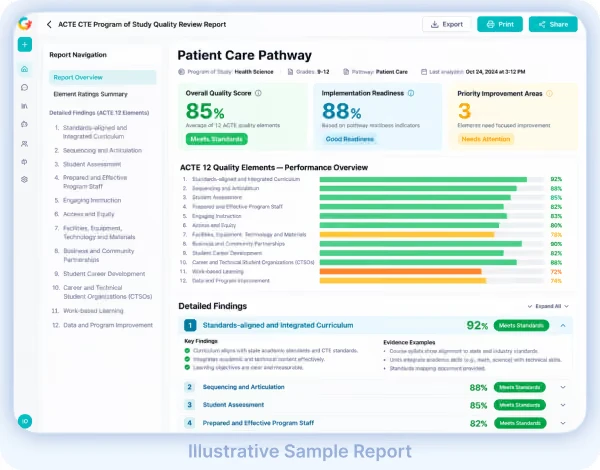
ACTE-informed quality review. Before a pathway is implemented, it is reviewed for readiness, alignment, industry connection, learning experiences and evidence, informed by ACTE's high-quality CTE framework. The report shows strengths, the evidence behind each rating and the next improvements to make. This illustrative sample shows a Patient Care pathway:
One connected lifecycle. Blueprint, Curriculum Planning, Assessment and Evidence, Portrait of a Graduate Portfolio, and District Insights work as one system, so pathway design, classroom units and student evidence stay aligned.
Where can I watch the Vibe Design Academy sessions?
All three sessions are free and on demand, each with its slides and a one-page Station Card:
- Session 1: Turn One CTE Standard Into Career-Ready Performance · Station Card 01, Find the Real Work Inside the Standard
- Session 2: Build a Career-Ready CTE Unit You Can Actually Teach · Station Card 02, Build a Unit You Can Actually Teach
- Session 3: Teach It, Verify It, Improve It · Station Card 03, Make Your Unit Work in a Real Classroom
Frequently Asked Questions
What is CTE curriculum development?
CTE curriculum development is the process of turning career and technical education standards and industry practice into units, lessons, performance tasks and assessments students can learn from. Strong CTE curriculum starts from the real work of a pathway and asks students to perform it to a professional standard.
What is a competency statement in CTE?
A competency statement is one sentence that names what a student will do, with what tools and conditions, to what quality, and for whom: "Given [tools and conditions], the student will [observable performance] to [quality expectation], as [professional context] requires."
What makes a CTE performance task authentic?
It has a real deliverable, a real audience who approves or returns the work, the industry's real tools, conditions and deadline, and a judgment call with more than one good answer defended with evidence.
Can AI write CTE curriculum?
AI can draft a full CTE unit, with lessons, slides, quizzes and supports, from a competency, task and rubric the teacher provides. The teacher reviews every lesson for technical accuracy, safety, standards alignment and depth of thinking before students use it. Curriculum Genie lists its sources so teachers can check them.
What was the Vibe Design Academy?
The Vibe Design Academy was a free, three-session professional learning series for CTE teachers led by Dr. Matt Rhoads, Ed.D., in fall 2026. Each session is available on demand with its slides and a one-page Station Card.