
Unpacking CTE Standards: Turn One Standard Into Career-Ready Performance
A CTE standard is written in school language. Your field runs on work language. In Session 1 of the Vibe Design Academy, Dr. Matt Rhoads shows CTE teachers how to unpack one standard into a competency statement: one sentence that names the tools, conditions and quality bar of real work, and the performance students must deliver.
Most CTE teachers came from industry. They know what good work looks like in a clinic, a shop or a studio. What a standard rarely tells them is how to turn one dense sentence into instruction they can teach on Monday and assess with confidence. Session 1 of the free Vibe Design Academy, led by instructional designer and author Dr. Matt Rhoads, takes on that translation. Educators joined from health sciences, visual communication, nutrition, business and shop programs, and practiced on their own pathway standards in real time.
Why are CTE standards hard to teach as written?
Standards are written by committees of state agencies, employers, unions and guilds, and they compress a lot of work into one sentence. Dr. Rhoads modeled the problem with California CTE Model Curriculum Standard AV.17.1 (Animation and Visual Effects): “Apply elements and principles of art and design to characters, props, and environments; differentiate lighting sources and types, and apply color theory to establish time, atmosphere and mood when lighting and shading a scene.” That is one sentence, three verbs and about nine things to teach.
The timing matters. Advance CTE released the modernized National Career Clusters Framework in October 2024, with 14 Career Clusters and 72 Sub-Clusters, and states are now realigning their own CTE standards to it, many in phases. As new standards arrive, every CTE teacher needs a repeatable way to read them and turn them into teachable, assessable work.
What are the four moves to unpack a CTE standard?
The process works on any standard in any pathway, and you can run it again on the next standard without help:
- Unpack: Underline the verbs and box the nouns, then sort them into what students must know and what they must do.
- Translate: Run the standard through four lenses: tools, conditions, quality expectations and professional context.
- Write the competency: Combine those lenses into one sentence that names an observable performance.
- Say why it matters: Write one line a student would believe and an industry professional would sign off on.

How do you unpack a CTE standard into what students must know and do?
Underline the verbs, box the nouns, then sort. The nouns become what students must know; the verbs become what they must do. Test every verb with one question: could you watch a student do it from across the room? “Differentiate” is observable. “Apply” is not, until you name the evidence.
For AV.17.1, the know list covered elements and principles of art and design, lighting sources and types, color theory, and how time of day and mood read on screen. The do list turned two vague “applies” into four observable behaviors: name a lighting setup, light and shade a prop, grade a scene to a stated time of day, and defend a color choice. Those behaviors point straight to the performance task you plan backward from.
How do you translate a CTE standard into your pathway?
Run the standard through four lenses it rarely spells out: the tools students use, the conditions they work under (a brief, a deadline, working alone or in a team), the quality expectations that make the work acceptable, and the professional context, meaning who would review or use this work in industry. For the lighting standard, that means a 3D package and reference stills, a modeled scene and a written brief due on a deadline, a scene that reads as the right time and mood with no caption, and a lighting artist who delivers passes to an art lead, takes critique and revises.
This is where a teacher’s industry experience does the heavy lifting. The standard never says what your old job required; you do. In the chat, participants named one condition their own standard assumes but never states: a nutrition standard that implies the full nutrition care process, an office applications standard that assumes fluency with professional document software, and a commercial art standard that depends on which commercial environment students design for.
What is a competency statement in CTE?
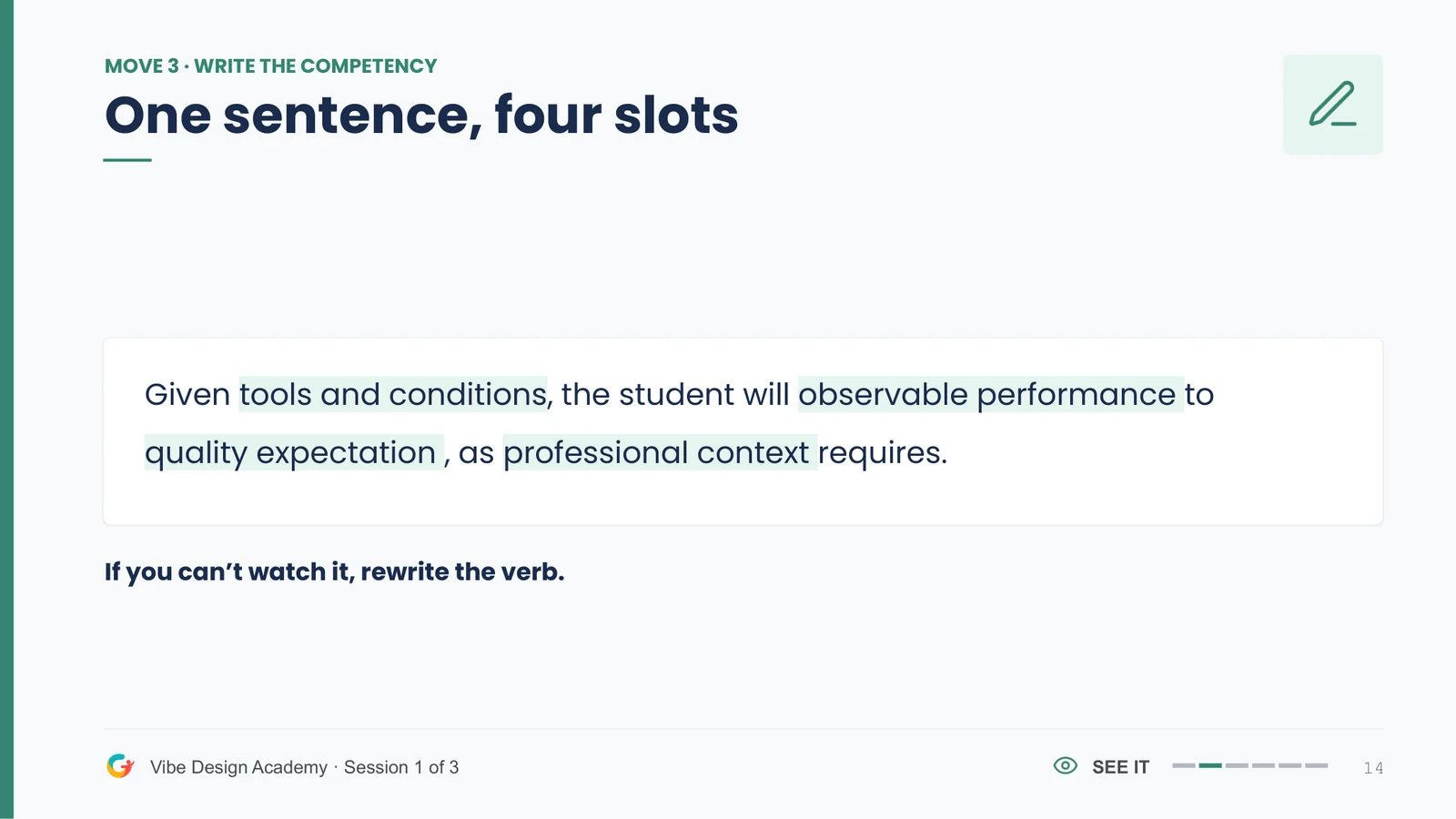
A competency statement is one sentence that says what a student will do, with what, to what standard and for whom. Dr. Rhoads uses a four-slot frame: Given [tools and conditions], the student will [observable performance] to [quality expectation], as [professional context] requires. His rule: if you can’t watch it, rewrite the verb.
For AV.17.1: “Given a modeled scene, a written mood brief, and a 3D package, the student will light and color-grade the scene so it reads as a stated time of day and mood without a caption, as a lighting artist delivering for art-lead review requires.”
The group then worked a second standard together, AV.17.6, which asks students to compare animation tools, workflows, visual styles and industry applications. The competency moved past listing differences: given a client brief, two animation pipelines and a one-week deadline, students produce the same five-second shot in both and recommend one, with trade-offs in time, cost and visual style. Career readiness here means producing the work and defending the decision to a producer.
How do you explain why a CTE skill matters to students?
Write one sentence a student would believe and your former boss would sign off on. For lighting: “Every shot you have ever watched was lit on purpose. Lighting tells the audience what time it is and how to feel before anyone speaks.” For animation: “Every studio decides how it will animate before anyone draws a frame. Pick the wrong pipeline, and the project runs out of time and money.”
Then test it twice. Would a sixteen-year-old believe it? Would an industry professional agree? If either answer is no, rewrite it until both are yes.
How do you build a CTE unit from a competency statement in Curriculum Genie?
In Curriculum Genie, start a new unit, set the grade level and length, select your state’s CTE standards and pathway, and paste your competency statement into the unit description. Curriculum Genie drafts the unit overview, key concepts, guiding questions and a lesson sequence tied to the standard you chose, and you can localize it to the industries and employers in your community. In the session, one standard became a two-week unit of ten lessons.
Then review it as an industry expert. Check the overview against your competency, the concepts against the standard, the instructional strategies against how the work happens in your field, and make sure every lesson builds toward the final performance task. “It doesn’t mean that once it’s generated, it’s done,” Dr. Rhoads said. Plan on two or three rounds of edits before the unit is ready for students.
Start free in Curriculum Genie
What is Station Card 01, and how do you use it?
Station Card 01, Find the Real Work Inside the Standard, puts the whole session on one page. The full version walks through six steps, from underlining verbs to naming the certification, capstone or job the standard points to, with a checklist for what good looks like. The 10-minute version is for a week with nothing left: underline every verb in one standard, write one sentence about what you would watch a student do, then rewrite it in the words you would use with a new hire on day one.
Download Station Card 01 (free PDF)

Frequently Asked Questions
Underline the verbs and box the nouns, then sort them into two lists: what students must know (the nouns) and what they must do (observable verbs). If you could not watch a student perform a verb, rewrite it as evidence you could see.
A competency statement is one sentence that says what a student will do, with what tools and conditions, to what quality bar, in what professional context. The frame is: Given [tools and conditions], the student will [observable performance] to [quality expectation], as [professional context] requires.
Tools, conditions, quality expectations and professional context. They capture what a standard assumes but rarely states, which is where a CTE teacher's industry experience matters most.
A one-page implementation guide for each session. Station Card 01 has a six-step full version and a 10-minute version for turning one CTE standard into a competency statement. Station Cards are instructional resources, not credentials.
Curriculum Genie lets you select supported state CTE standards and your pathway, then paste your competency statement into the unit description to build a standards-aligned unit. Review the first draft against your competency and industry expectations before you teach it.
Turn your next CTE standard into a unit you can teach
Run the four moves, then build and review the unit in Curriculum Genie.