
Build the Curriculum: Turn a Career-Ready Outcome Into a CTE Unit You Can Teach
A career-ready outcome is not yet a lesson. In Session 2 of the Vibe Design Academy, Dr. Matt Rhoads, Ed.D., shows CTE teachers how to turn a competency into an authentic performance task with GRASPS, define quality with a four-row rubric, and build a ten-lesson unit in Curriculum Genie that teaches every skill the task will assess.
Session 1 of the free Vibe Design Academy turned one CTE standard into a competency statement. Session 2 picks up from there and works backward: decide what proof of learning looks like, design the task a professional would recognize, then build the lessons that prepare students to deliver it. CTE teachers and leaders joined from construction, computer science, information technology, coding and video production programs, and from a regional educational cooperative, in states including Mississippi, Texas, Florida and Kentucky.
Who is Dr. Matt Rhoads?
Matthew Rhoads, Ed.D., is a supervisor and lecturer in San Diego State University's College of Education and a doctoral dissertation chair. He is the author of ten books on instruction, educational technology, coaching and leadership, including Instruction Without Boundaries and Co-Teaching Evolved. He supports CTE teachers across a number of schools in North San Diego County, consults with teachers nationally on curriculum and course design, and leads all three sessions of the Vibe Design Academy.
What makes a CTE performance task authentic?
An authentic task is the real job, scaled for a classroom. Dr. Rhoads uses four tests. A real deliverable: something a professional actually hands over, not a worksheet. A real audience: someone who approves the work or sends it back, a role the teacher or classmates can play. Real constraints: the industry's tools, conditions and a deadline. And real judgment: more than one good answer, defended with evidence.
The gut check is simple. If a working professional would not recognize the task, it is not authentic, and if a student can pass by following steps without ever making a judgment call, the task needs a complication. The session grounded this in Grant Wiggins' 1990 definition: “Assessment is authentic when we directly examine student performance on worthy intellectual tasks.”
How do you turn a competency into a performance task with GRASPS?
GRASPS is a performance task design frame from Grant Wiggins and Jay McTighe's Understanding by Design: Goal, Role, Audience, Situation, Product, Standards. If you wrote a competency in Session 1, most of the task is already there. Your tools and conditions become the Situation, the professional context becomes the Role and Audience, the quality bar becomes the Standards, and your observable verb becomes the Goal and Product.
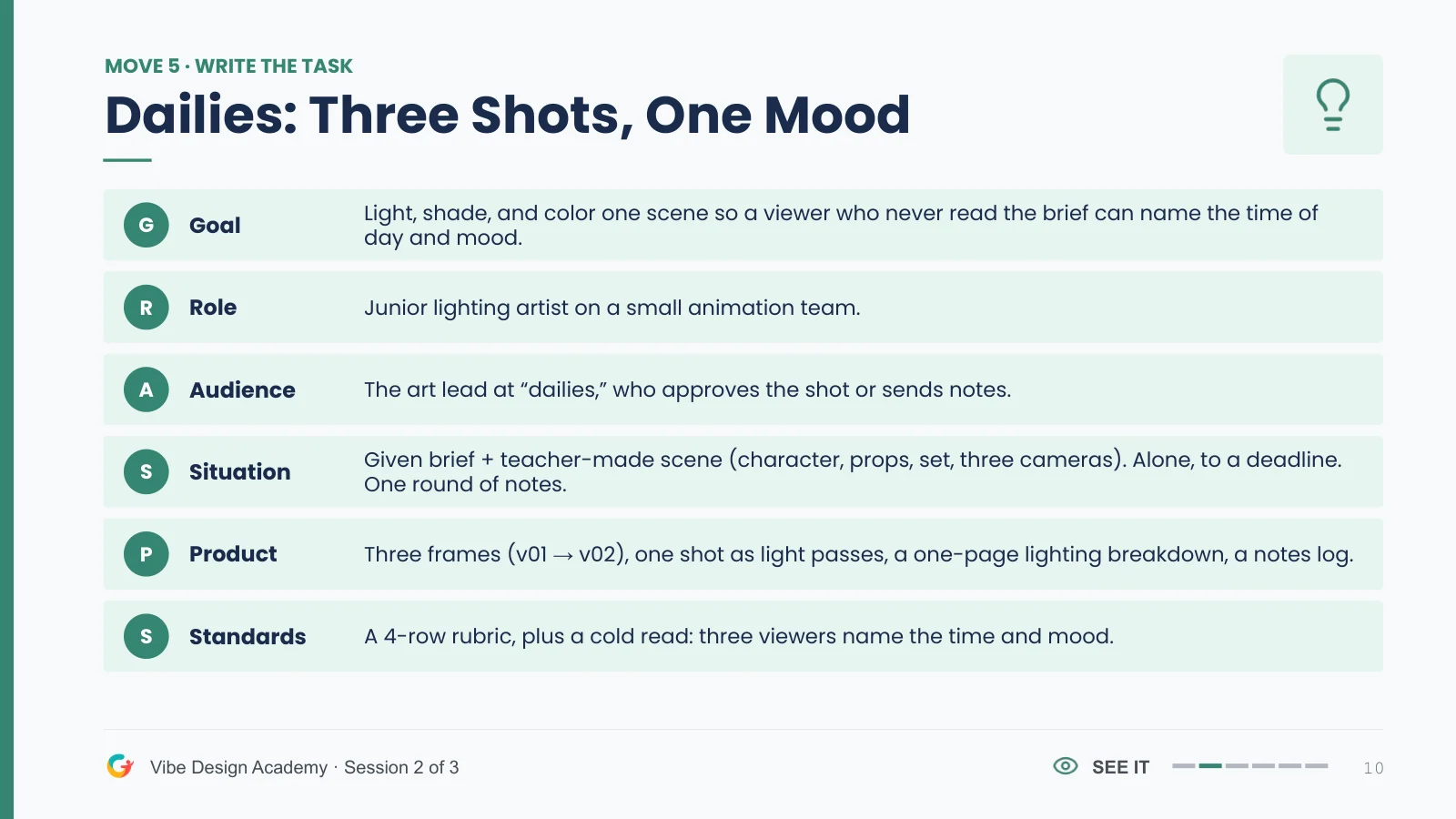
Dr. Rhoads modeled it with California CTE Model Curriculum Standard AV.17.1 (Animation and Visual Effects) and the Session 1 competency: given a modeled scene, a written mood brief and a 3D package, the student will light and color-grade the scene so it reads as a stated time of day and mood without a caption, as a lighting artist delivering for art-lead review requires. Note that students receive the brief. Asking them to write it would change the conditions the competency sets.
| GGoal | Light, shade and color one scene so a viewer who never read the brief can name the time of day and mood. |
|---|---|
| RRole | Junior lighting artist on a small animation team. |
| AAudience | The art lead at dailies, who approves the shot or sends notes. |
| SSituation | A given brief and teacher-made scene with a character, props, a set and three cameras. Alone, to a deadline, with one round of notes. |
| PProduct | Three frames (v01 to v02), one shot as the light passes, a one-page lighting breakdown and a notes log. |
| SStandards | A four-row rubric plus a cold read: three viewers name the time and mood. |
How do you write a rubric for a CTE performance task?
Keep it to three to five criteria and make Proficient equal the competency. The Dailies rubric uses four rows: reads without a caption, light and shade, consistency across shots, and professional delivery and revision. Each row moves from Not Yet to Developing, Proficient and Industry-Ready.
The first row shows the shift from impression to evidence. At Not Yet, viewers cannot identify a clear time or mood. At Proficient, three cold readers identify the intended time of day and mood through light and color. At Industry-Ready, they also point to the matching visual evidence. In the session, participants tried the cold read themselves on three lit scenes built with Curriculum Genie and did not all agree, which is exactly the conversation the rubric is meant to start.

What does a CTE performance task look like for another standard?
The group practiced on AV.17.6, which asks students to compare animation tools, workflows and visual styles. The competency: given a client brief, two animation pipelines and a one-week deadline, the student will produce the same five-second shot in both and recommend one, as a studio choosing its pipeline requires. Participants named the product in the chat: two versions of the same shot.
The finished task, Pick the Pipeline: a junior animator on a studio's pitch team makes the shot in 2D and 3D and delivers a one-page pipeline pitch on time, cost and look to the producer who approves the budget. The twist that forces judgment: the client wants “warm and handmade” on a 3D budget. Making two versions is not enough. Students have to defend which one fits the brief.
Where should a CTE performance task force a judgment call?
Name one complication that forces a decision, not just more work. Dr. Rhoads' welding example: fit-up is off by 1/16 inch and the inspector arrives at 2:00. In animation, it is the trade-off between quality, time and budget. The complication should expose the reasoning students need to practice and show how professionals decide while meeting standards and any regulations that apply.
How do you build a CTE unit from a performance task in Curriculum Genie?
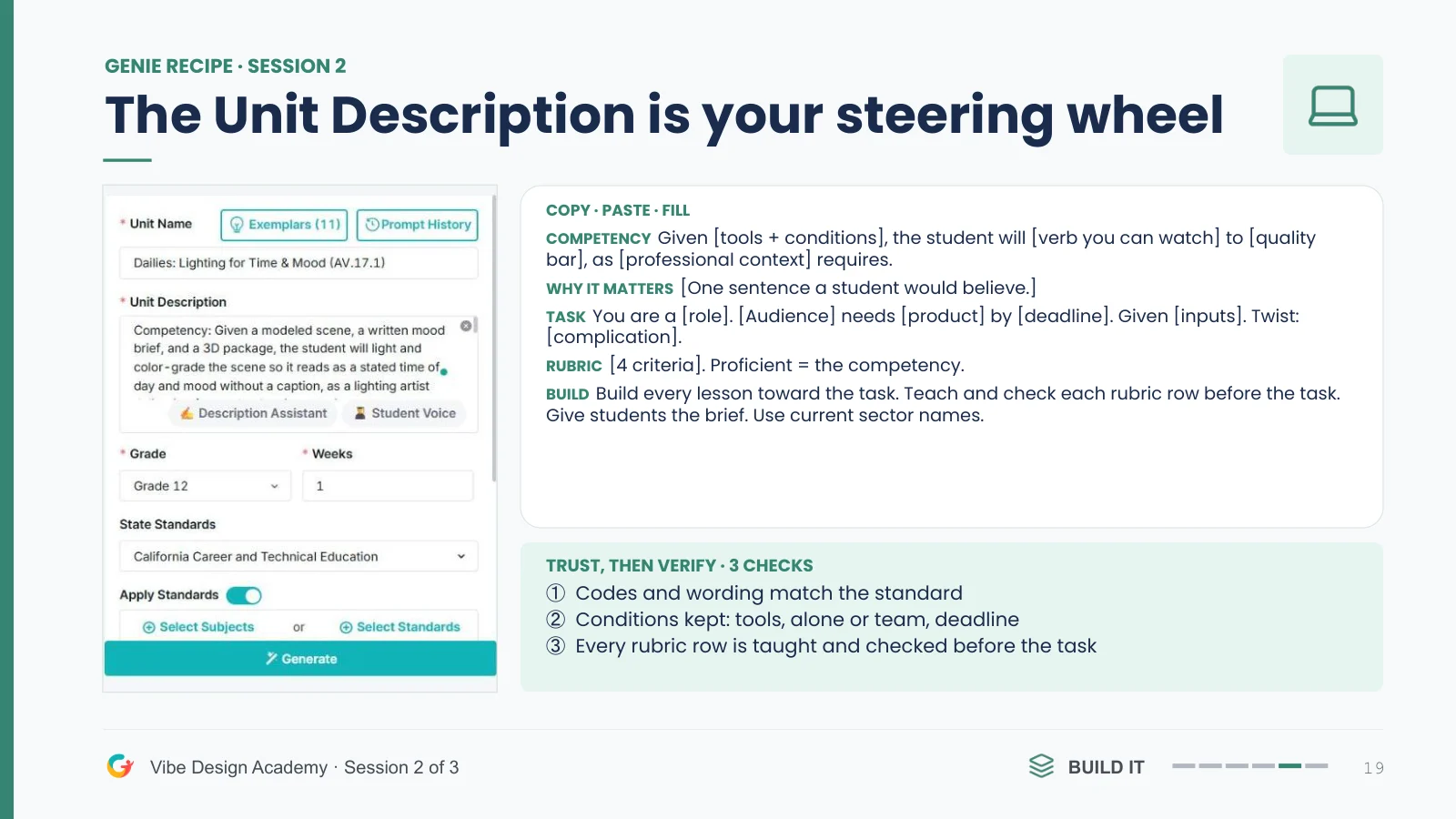
Put the task in first. In a new Curriculum Genie unit, the unit description is your steering wheel: paste the competency, one sentence on why it matters, the task with its twist, and the four rubric rows, and add the instruction to build every lesson toward the task and teach each rubric row before it. Then select your state's CTE standard and generate. Dr. Rhoads recommends starting small: one standard and a two-week unit, with only a few lesson options selected, so you can learn the output before you scale up.
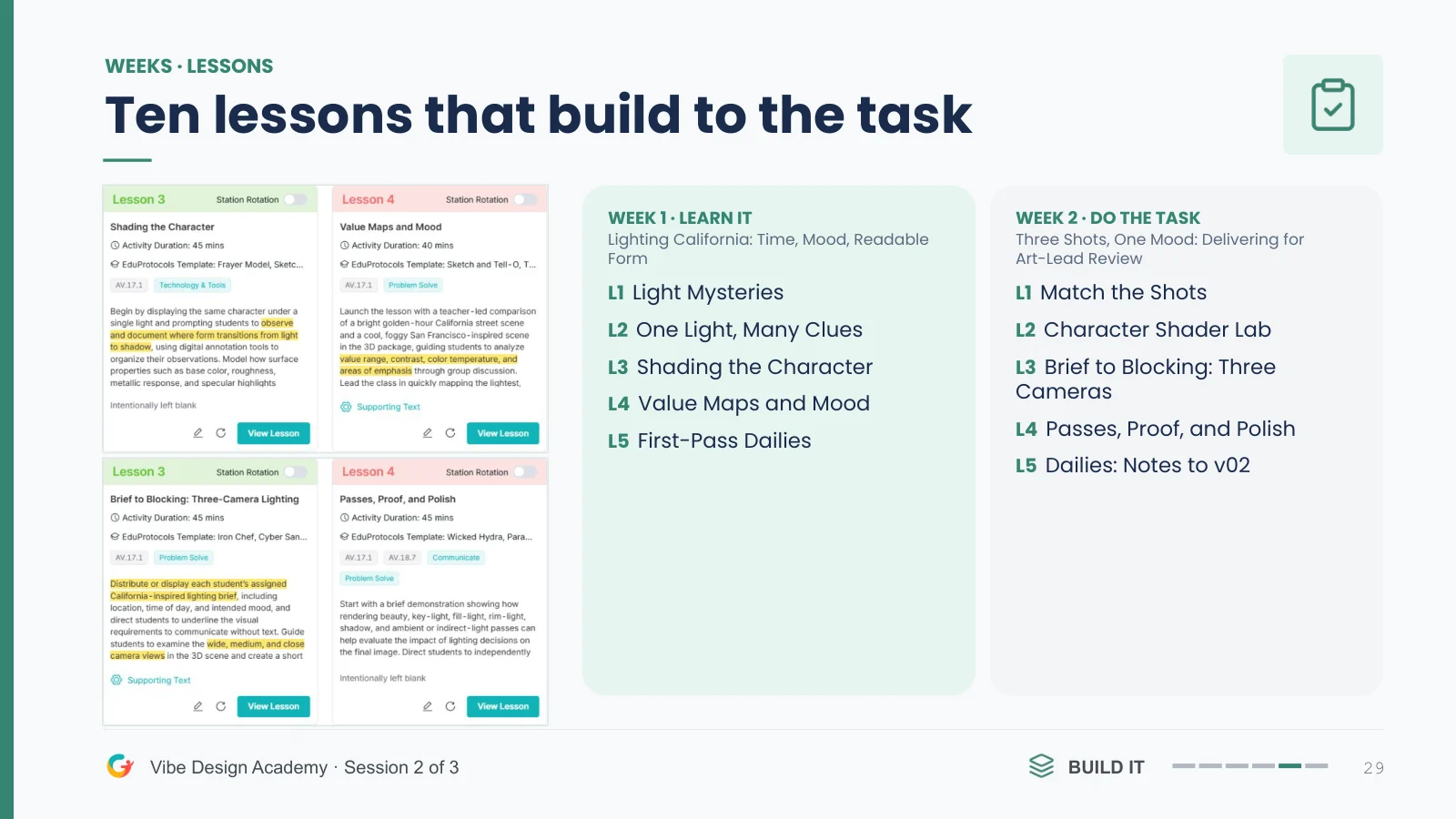
In the demonstration, the AV.17.1 task became ten lessons across two weeks: a Learn It week (Light Mysteries, One Light, Many Clues, Shading the Character, Value Maps and Mood, First-Pass Dailies) and a Do the Task week that ends with Dailies: Notes to v02. Each lesson included objectives and a question of the day, teacher slides, a reading passage, a quiz with Depth of Knowledge levels and an answer key, EduProtocols activities and UDL supports. When the first draft missed shading and form, one Enhance Unit prompt added the concepts across every lesson. Districts can also add their Portrait of a Graduate and localize units to nearby industries and employers.
How do you check an AI-generated CTE unit before students use it?
Filling in the unit description is the easy part. Checking and revising is where you spend most of your time, and it is where your industry expertise matters. Run three checks before you confirm each step:
- Codes and wording match the standard.
- Conditions are kept: the same tools, alone or in a team, and the same deadline.
- Every rubric row is taught and checked before the task.
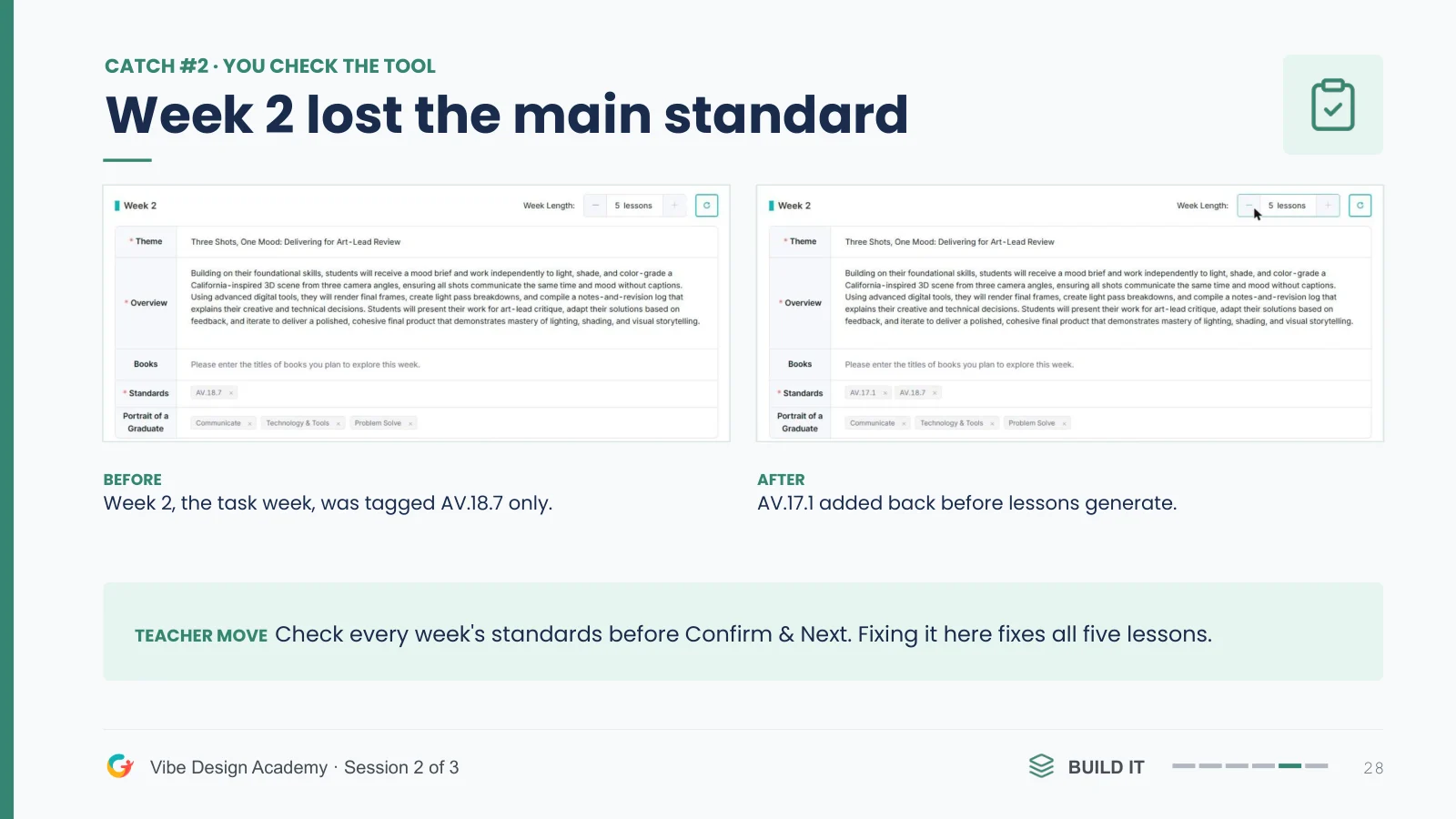
The demo caught three problems this way. Curriculum Genie's alignment review flagged AV.18.8 as a weak fit for a solo lighting task, and the teacher accepted the change. Week 2, the task week, had lost AV.17.1, so it went back in before lessons generated, which fixed all five lessons at once. And the built-in rubric scored general skills rather than lighting, so an Enhance Lesson prompt replaced it with the four task rows. Fix things early: a mismatch in week one carries through everything after it.
Where can I view the slides from this CTE webinar?
Click through Dr. Rhoads' full Session 2 deck below, from the four authenticity tests and the GRASPS worked example to the rubric, the unit description recipe and the three catches. Use the arrows to move between slides, or open it full screen.
What is Station Card 02, and how do you use it?
Station Card 02, Build a Unit You Can Actually Teach, puts the session on one page. The full version has six steps: define career-ready performance, name the evidence that proves it, design an authentic performance task, build the unit in Curriculum Genie and read it against your outcome, sequence the opening lessons, and start the student-facing materials. The 10-minute version is for a week with nothing left: generate the unit and change only the assessment. Everything else can wait until you have taught a week of it.
Download Station Card 02 (free PDF)

New to the series? Start with Session 1, Turn One CTE Standard Into Career-Ready Performance, to write the competency statement this session builds on.
Your redemption code is on its way. It can take a minute or two, so check your spam or promotions folder if you don't see it.
Open Curriculum GenieBack to the webinarYour redemption code is on its way. It can take a minute or two, so check your spam or promotions folder if you don't see it.
Open Curriculum GenieFrequently Asked Questions
It mirrors real work: a deliverable a professional would actually hand over, a real audience who approves it or sends it back, the industry's tools, conditions and deadline, and a judgment call with more than one good answer defended with evidence. If students can pass by following steps without deciding anything, add a complication.
Goal, Role, Audience, Situation, Product and Standards. GRASPS comes from Grant Wiggins and Jay McTighe's Understanding by Design. In CTE, a competency's tools and conditions become the Situation, its professional context becomes the Role and Audience, and its quality bar becomes the Standards.
Three to five. The Vibe Design Academy example uses four rows, each scored Not Yet, Developing, Proficient and Industry-Ready, with Proficient written to match the competency so students can self-check against it.
The competency, one sentence on why it matters, the performance task with its complication, and your rubric rows, plus the instruction to build every lesson toward the task. Then tag the one standard the task assesses. Start with one standard and a two-week unit.
Run three checks: codes and wording match the standard, the task conditions are kept (tools, solo or team work, deadline), and every rubric row is taught and checked before the task. Check each week's standards before generating lessons, and review every lesson before students use it.
Build your first performance-task unit, free
Paste your competency, task and rubric into Curriculum Genie and generate a two-week unit. Your first four units are free.