Applying the Pyramid Model: Self-Regulation and Classroom Management Strategies for PreK & TK
Self-regulation isn’t something children bring to TK. It’s a skill we teach. In this session, TK teacher Janice Galarza and Dr. Erica Dallas show how the Pyramid Model helps PreK and TK teams build it on purpose, through routines, visuals and co-regulation, before the hard moments happen.
Every TK teacher knows these moments: cleanup that turns into a standoff, a transition that ends in tears, a child who can’t wait for a turn. In the first session of the California Early Learning Webinar Series, Janice, a TK teacher at Chula Vista Elementary School District with 16+ years in preschool, PreK and TK, joined Dr. Erica Dallas, early childhood educator and consultant, to reframe them. Their shift is simple: stop asking “How do I manage this behavior?” and start asking “What can I put in place so this child succeeds?”
What is the Pyramid Model in early childhood education?
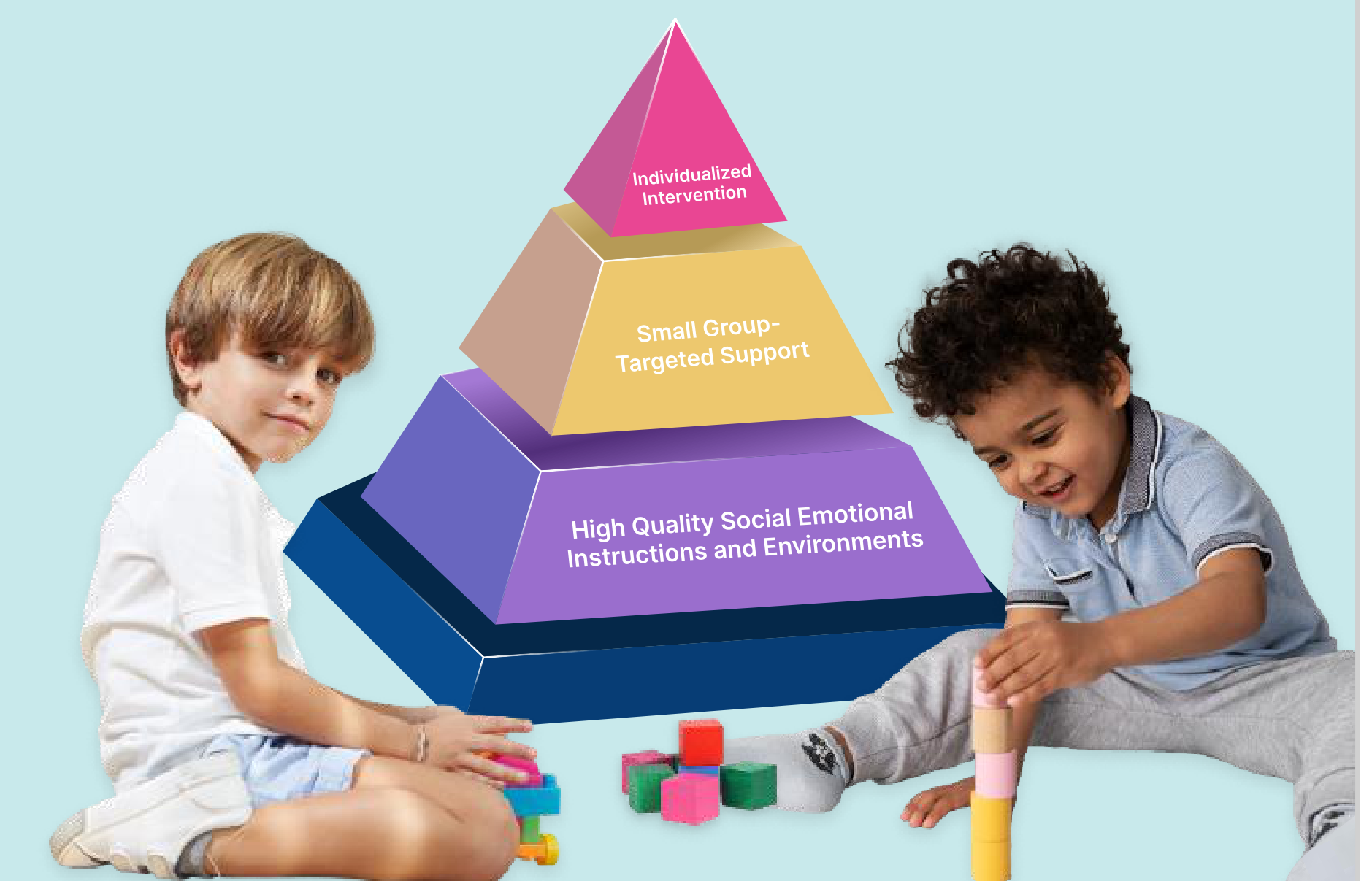
The Pyramid Model is a tiered framework for promoting young children’s social-emotional development and preventing challenging behavior. Its foundation is knowledgeable, supported educators. Every child gets nurturing relationships and a high-quality, supportive environment; some children get targeted social-emotional teaching; a few get individualized intervention.
As Dr. Dallas put it, “We’re not placing children in categories. We’re matching layers of support to their needs.” The approach is backed by research she cited in the session: a randomized study of 40 preschool teachers and 494 children found that training plus practice-based coaching improved implementation, and children were rated as having stronger social skills and fewer challenging behaviors.
Why is self-regulation a skill to teach, not a prerequisite for TK?
Self-regulation is a developing capacity in 4- and 5-year-olds, and it’s at work all day, not only when a child needs to calm down. We ask young children to attend to a story, pause an impulse, leave a favorite activity, hold a direction in mind long enough to follow it, and recover after frustration. For a four-year-old, those are big expectations.
The goal isn’t a quiet classroom. It’s children who can feel excited, disappointed or upset and still find their way back to learning. Those skills grow through repeated experiences with adults who model them, prompt them and practice them alongside the child.
What is co-regulation, and how does it build self-regulation?
Co-regulation is when a calm, responsive adult helps a child manage emotions and behavior. Before children regulate on their own, they regulate with us, and our tone, proximity, predictability and responsiveness all matter.
Janice describes it as a gradual release: first I model what I do when I’m upset, then we do it together, then the child practices it alone. Support fades as skills grow, but not on a fixed schedule. A child who managed well this morning may still need you this afternoon. In the PTKLF, this work lives in Social-Emotional Development, in children’s interactions and relationships with adults.
How do you teach self-regulation before the hard moment?
Teach calming strategies when a child is calm, “at zero, not at ten.” A child in a full meltdown can’t learn a new tool. Build the toolbox first: taking a breath, asking for help or a break, break cards, waiting with a timer, first-then cards. When the hard moment comes, the child reaches for something familiar instead of something new.
Language matters just as much. Replace vague corrections with skills a child can use: “Stop running” becomes “Let’s use our walking feet to keep everyone safe,” and “Be nice” becomes “Can I have a turn when you’re finished?” Dr. Dallas’s rule of thumb: correct less, coach more.
Which strategies help PreK and TK children with transitions?
Make the day visible. When children can see what’s happening now and what comes next, transitions bring less anxiety and resistance. Janice walked through the supports she uses in her own classroom:
- Visual schedules: a whole-class schedule, plus a personal schedule split into morning, midday and afternoon for a child who finds the full day overwhelming.
- First-then boards: the less preferred task first, then a preferred activity.
- Two-minute warnings and visual timers: a cue before cleanup, so play doesn’t end abruptly.
- Photo labels: a picture of the block shelf exactly as it should look, by shape and color.
- Social stories: a short story for each routine, with the child’s own photo in it.
Before adding a consequence, Janice checks three things. Can the child tell what’s happening now and next? Have we explicitly modeled and practiced the routine? Can this child participate with the supports in place? If the answer is no, she redesigns the routine first.
What should teachers do during a challenging moment?
Get curious before getting corrective. Ask what happened right before, what skill the moment required and what support was available. Then work through five steps from the session, a practical Pyramid-informed synthesis rather than a formal NCPMI protocol:
- Connect: establish safety and regulate your own response first.
- Clarify: use simple language and a familiar cue, often three words or fewer.
- Support: offer a tool the child has already practiced.
- Teach: name a safer response the child can use next time.
- Adjust: if the pattern repeats, change the environment or the support plan.
How do these practices connect to PTKLF and DRDP 2025?
Visual schedules support routines and flexibility. Teaching emotion regulation supports Social-Emotional Development. Conflict-resolution practice supports peer relationships and problem solving. Those skills then show up in DRDP 2025, which relies on authentic observations across time and settings, not a single activity.
Dr. Dallas also cautioned against confusing compliance with competence. A child may show understanding without eye contact or without sitting at the table, and a child with a disability may need a different path to participation. Equity means meaningful expectations with more than one way to show growth.
What this means for leaders, coaches and teachers
For administrators and coaches, measure what teachers do consistently, not how many visuals are on the wall. Observe one routine and help strengthen one support. For teachers, start small: choose one routine, identify one barrier and put one meaningful solution in place. These skills keep developing into kindergarten and beyond, which matters even more as TK classrooms serve younger children.
Learning Genie’s Discover & Grow curriculum for PreK and TK opens with Unit 0, Advancing the Pyramid, which Janice helped build. It brings social-emotional instruction, small-group targeted support and individualized intervention into the first weeks of school.
Frequently Asked Questions
The Pyramid Model is a tiered framework for promoting young children's social-emotional development and preventing challenging behavior. Every child gets nurturing relationships and supportive environments; some get targeted social-emotional teaching; a few get individualized intervention.
Teach it like any other skill: model it, practice it together, then let the child try alone. Teach calming tools when children are calm, and use predictable routines, visual schedules and first-then cards so children know what comes next.
Co-regulation is when a calm adult helps a child manage emotions and behavior. Self-regulation is the child doing it independently. Young children build self-regulation through many repeated experiences of co-regulation.
Yes. In the session, Janice Galarza explained that she uses a personal visual schedule as a Tier 2 strategy for children who need more support than the whole-class schedule provides.
Visual schedules, emotion-regulation teaching and conflict-resolution practice support PTKLF Social-Emotional Development. DRDP 2025 ratings then draw on authentic observations of those skills across time and settings.
Start the year with self-regulation built in
Learning Genie's Discover & Grow curriculum opens with a Pyramid Model unit on safety and self-regulation.