An AI Curriculum Agent for Standards-Aligned Unit and Lesson Planning
Key Information Overview
- Full Standards Traceability: Trace every standard from high-level unit goals down to specific lesson tasks and assessment evidence, creating a clear audit trail.
- Seamless Interdisciplinary Design: Automatically sequence multi-subject standards into a logical instructional flow that fits your district’s academic calendar.
- Actionable Portrait of a Graduate: Move 21st-century competencies from vision statements into daily practice by embedding them directly into classroom routines.
- Executable Differentiation: Bridge the “last mile” by turning complex IEP/504 needs and UDL principles into specific, lesson-level preparation for every teacher.
- Portable Assessment Ecosystem: Package high-quality formative assessments in common formats to ensure consistency and reusability across the district.
- Collaborative Co-Creation: Rapidly produce editable slides and documents, enabling curriculum teams to co-develop and localize content in hours, not months.
- Evidence-Backed Outcomes: Built on research-backed results — ESSA Tier 3 evidence.
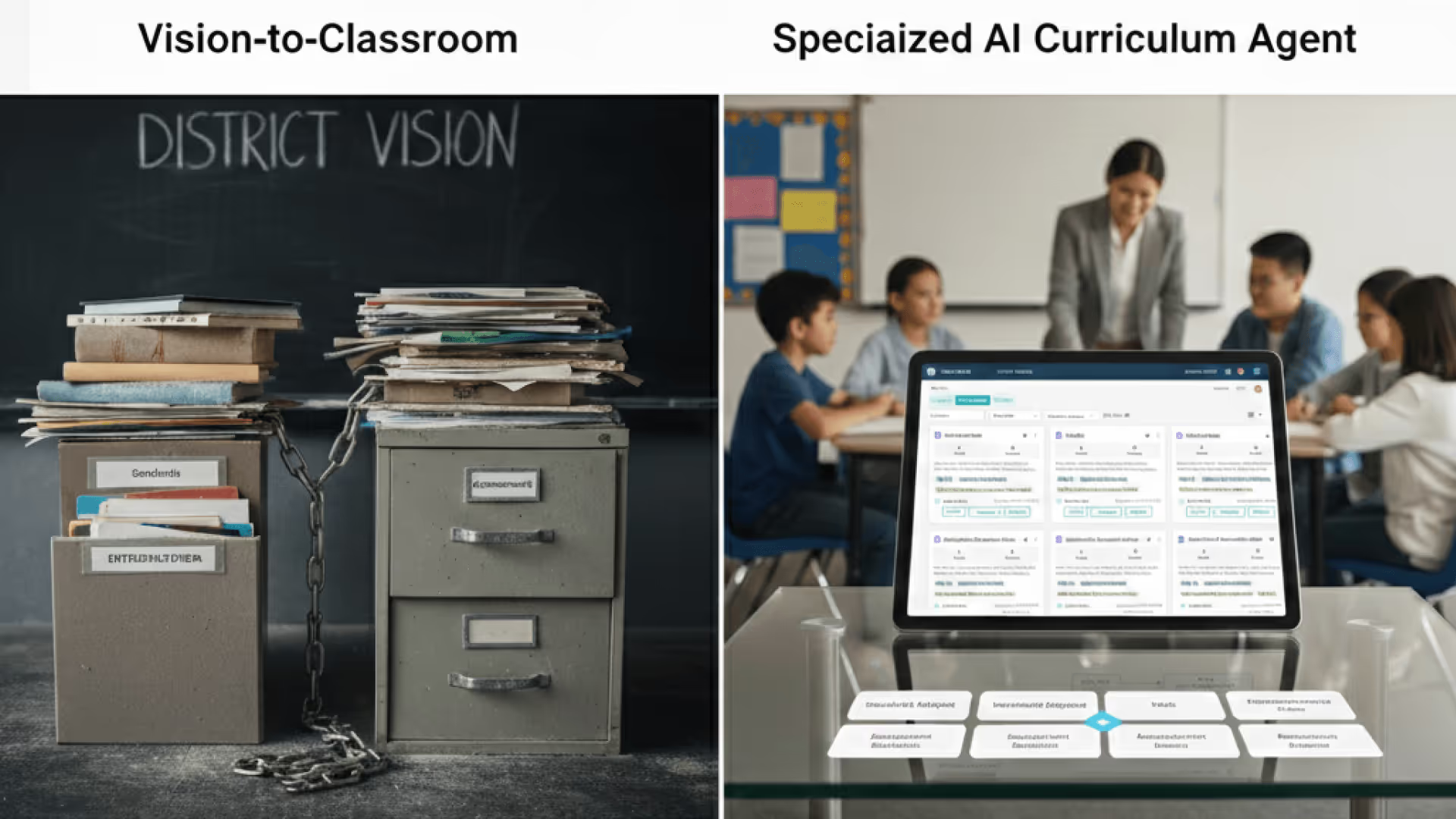
Why District Initiatives Stall: The "Vision-to-Classroom" Gap
In many districts, improvement efforts don’t fail for lack of vision—they fail because district curriculum planning often lacks a reviewable execution chain. District teams can use this operational approach to reduce overload and rebuild coherence: Organizing Curriculum Priorities for School Districts. Standards, instructional materials, assessment, and differentiation supports often operate in silos, disconnected from the daily reality of the classroom. For district and school leaders, the critical challenge remains: Is our standards-aligned planning visible, auditable, and scalable across every school and classroom?
This is where a Specialized AI Curriculum Agent changes the game. While generic AI tools merely summarize information, Curriculum Genie builds a coherent instructional ecosystem that translates high-level district priorities into actionable classroom steps, ensuring your vision finally reaches every student's desk.For research-backed validation, see our ESSA Tier 3 evidence.
6 Strategic Decisions to Ensure Instructional Coherence
1. How Can Districts Verify Standards Alignment as a Traceable Execution Chain?
For most districts, "standards alignment" is often just a checkbox—a compliance label slapped onto a document. But true standards-aligned unit & lesson planning is only verifiable when leaders can trace a clear execution chain from a state standard to a unit goal, into a specific classroom task, and finally to assessment evidence.
Establishing a Classroom-Traceable Execution Chain
Curriculum Genie eliminates "standard drift" by creating a transparent audit trail that connects high-level goals to classroom reality. It begins by translating complex standards into teachable unit concepts and goals, which are then organized into a workable weekly and daily sequence. Leaders can see exactly how a standard is distributed across a unit, which specific lessons tackle it, and which assessment items prove student mastery. It turns an abstract list of requirements into a reviewable, data-driven map of instruction.
2. Why Do Interdisciplinary Units Fail?
Interdisciplinary units break down when multiple standards are combined without a shared instructional sequence that governs how concepts build over time. Without this underlying structure, interdisciplinary work becomes a thematic overlay rather than a rigorous and coherent learning pathway.
Establishing a Shared Instructional Framework
To achieve true coherence, interdisciplinary planning must follow a logical progression that moves from a Big Idea or Essential Question into a Concept Progression, and finally into day-by-day tasks and outputs. This ensures that secondary subjects aren't just “added on” but are central to the learning pathway, serving as coordinated supports within a single, unified learning journey.
Ensuring Rigor through Balanced Integration
High-quality interdisciplinary work depends on balancing multiple standards without overwhelming the learner. Success requires scaffolding complex tasks and ensuring a logical distribution of standards across the entire unit. By managing these instructional boundaries, districts ensure that academic rigor is maintained while the cognitive load remains manageable and purposeful throughout the instructional calendar.
Driving Engagement through Local Relevance
The ultimate measure of instructional coherence is the student experience. When engagement declines, connecting abstract ideas to students’ local context and lived experiences can strengthen relevance and drive deep engagement.(see localized curriculum examples)
3. How Can a Portrait of a Graduate Move from Vision to Observable Competencies?

A Portrait of a Graduate or learner profile often remains aspirational because it lacks a clear execution path. These competencies only become operational when they function as system-level design constraints—appearing in unit goals, lesson tasks, and student work rather than remaining at the vision level.
For a district-ready implementation model, see Implementing Portrait of a Graduate: An AI-Powered 4-Step Model.
Defining Observable Performance
PoG competencies function effectively when treated as an additional set of system expectations—made visible through student work products and learning behaviors rather than inferred solely from coverage metrics. This requires a shift where learning extends beyond standards mastery to include writing, presenting, researching, collaborating, and communication skills that students must demonstrate across contexts.
Avoiding the Vision-to-Classroom Gap
To prevent a gap between district strategy and classroom reality, competencies should reappear across units and lessons through explicit touchpoints tied to tasks and classroom routines, rather than being confined to occasional projects.
4. How Can Districts Turn IEP/504 Needs into Executable Actions?
Inclusive and differentiated instruction often fails at the execution level—not because principles are unclear, but because support information is rarely translated into lesson-specific preparation and in-the-moment instructional actions.
The Root Cause: The “Last-Mile Translation” Gap
The core issue is the “last-mile translation” from student support information to daily instruction. Eligibility details and IEP/504 accommodations often live in silos, disconnected from the daily teaching flow. Because this data does not reliably convert into actionable checklists or collaboration prompts for a specific lesson, differentiation often remains a compliance statement rather than a classroom reality.
Embedding Support into Design Routines
A practical solution is to embed differentiation directly into the lesson design routine: define lesson goals and tasks, convert support needs into what to prepare and what to watch for during instruction, clarify collaboration moves, then refine after implementation. The source emphasizes making collaboration more intentional and preparation more actionable.
5. How Can Formative Assessment Become a Scalable District Asset?

Formative assessment becomes a district-level asset when items are explicitly connected to lesson goals and standards, stored in portable formats, and reused across classrooms rather than being recreated by individual teachers.
Why It Matters
When assessment is both aligned and portable, it can move beyond an individual teacher artifact into a district asset—supporting classroom adjustments while enabling cross-site reuse and continuous improvement.
How It Becomes Visible in the System
Leaders should be able to see: the mapping from items to standards/lessons; batch export in common formats (e.g., CSV) to enable portability; and joint archiving with unit materials to sustain iterative item banks/sets.
6. How Can Districts Support Scalable Implementation through Team Co-Creation?
Scaling high-quality instruction through modernized district curriculum planning requires shifting from “individual documents” to “organizational assets” that teams can build in parallel, review together, and store in portable forms to reduce rework and quality variance.
Modernizing the Instructional Execution Chain
To ensure consistency across all school sites, districts must move from fragmented planning to a modernized development process:
- Team workflow: distribute lesson/element production across a small group, then review and merge into a final version—shortening development cycles compared with traditional long-horizon planning.
- Asset form: keep units, lessons, slides, and materials in structured archives (e.g., folderized) and common export forms to fit local ecosystems.
Observable Evidence of Scalable Success
When this works, districts see more consistent structures across sites, easier sharing and onboarding, and a reallocation of team effort from “starting from scratch” to review, differentiation, and support strategy refinement—consistent with the source’s description of faster team production and portability.
Implementation in Action: From Standards to a Two-Week Sequence
The following example illustrates how AI transforms a localized "Farm to Table" theme (set in San Diego) into a rigorous, two-week instructional unit aligned with NGSS standards. Curriculum Genie converts high-level inputs into a transparent, day-by-day sequence, providing leaders with a concrete “audit trail” to verify exactly how learning goals and standards are operationalized into daily classroom tasks.
For district leaders, this ensures that local relevance and academic rigor are not just aspirations, but reviewable artifacts that can be scaled consistently across every school in the district.
Moderators
Frequently Asked Questions
Alignment is verifiable when a single unit package clearly shows standards coverage → where each standard lives in the lesson sequence → the tasks/assessment checkpoints that reflect it, in a way leaders can review and spot-check. Without that traceability, districts cannot reliably address the risk of teacher-created materials drifting from state standards.Districts can standardize this packaging using an AI unit planner workflow and AI lesson planning workflow.
They become real when they show up in the unit-and-lesson structure. Interdisciplinary work requires an explicit plan for how multiple standards are carried through a coherent lesson sequence; a Portrait of a Graduate / learner profile requires grade-band translation and visible lesson-level touchpoints tied to concrete student work. This is what makes rollout, calibration, and professional learning feasible at scale.
It looks like IEP/504 needs being translated into the smallest actionable units: lesson-specific preparation and in-the-moment instructional prompts. This is essential for general and special education teams with limited co-planning time. Without that conversion, differentiation tends to remain principle-level and inconsistent in practice.
Key requirements include assessment portability (e.g., CSV exports that flow into existing systems) and robust data governance. Districts need clear guardrails for student data use and credible security validation to reduce adoption friction. Use this checklist for review and responsible implementation: best practices for using Curriculum Genie appropriately.
Ready to Transform Your District?
Schedule a Demo with Curriculum Genie to see how Agentic AI can support your curriculum goals.