Organizing Curriculum Priorities for School Districts
Key Information Overview
- Fold Priorities, Don't Stack: Solve "initiative overload" by integrating standards, PoG, and UDL into single tasks rather than stacking them as separate programs.
- Alignment is Student Action: Strong alignment means student behaviors match standard requirements, ensuring a coherent link between learning targets, assessments, and daily instructional tasks.
- PoG as a K-12 Continuum: Operationalize "PoG Traits" as a developmental roadmap embedded in daily lessons, moving beyond mission statements.
- Localization Drives Engagement: Use local community anchors to ground abstract concepts, turning localized curriculum into a pedagogical engine for student meaning-making.
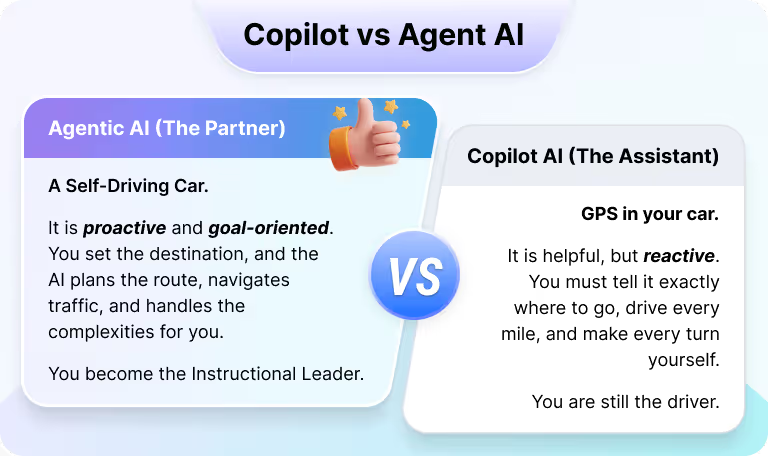
- Agentic AI as a Partner: Transition from reactive "Copilots" to proactive "Agentic AI" that executes complex, multi-priority curriculum workflows automatically.
- Reclaim Human Judgment: AI’s highest value is automating documentation and alignment, positioning ai for teacher as infrastructure rather than instruction, and freeing teachers to focus on expert feedback and student support.
What Problems Does This Solve?
When district goals are too numerous and disconnected, “initiative overload” often occurs: teacher workload increases, classroom implementation becomes fragmented, and instruction turns into piecemeal execution. This page presents an operational organizing approach: using “change the lens” to achieve strategic integration, defining strong alignment as students’ actions fully matching what learning standards require, and improving instructional coherence and assessability. AAgentic AI in Education—using AI Education Tools such as an AI Curriculum Generator and other Generative AI for Education workflows—makes this approach achievable at scale.—see our ESSA evidence-based AI curriculum for how the workflow is validated and implemented.
Use one multi-week unit to fold standards, Portrait of a Graduate, localization, and UDL strategies into the same classroom task; use strong alignment to ensure assessments and activities are consistent; and use a roadmap to move from pilot to scalable governance.
Why School Districts Easily Fall Into “Initiative Overload”
Many districts are not lacking the “right” educational priorities. The real challenge is that there are too many priorities, disconnected from one another, which eventually land in classrooms as “initiative overload.” New goals are often added as extra programs, forcing curriculum to continuously stack initiatives, fragmenting instruction and scattering resources.
The key to solving this problem is not “adding more,” but “changing the lens”: allowing the same learning experience to carry multiple priorities through a repeatable planning workflow that makes those priorities visible, discussable, and assessable through what students are actually doing.
Next, we use four core concepts (expanded standards, Portrait of a Graduate continuum, strong alignment, and localization) to explain how multiple priorities can shift from an “add-on checklist” to a cohesive multi-week unit trajectory that brings vision into everyday classrooms.
District Leadership Blueprint: Driving Outcomes with Agentic AI
1. Expanding the Goal: From Content Checklists to Whole-Child Outcomes
Expanding the goal of a district curriculum means upgrading “standards” from a single content checklist to a multidimensional learning outcome system—explicitly focused on driving educational outcomes rather than managing disconnected initiatives.
Why Standards Must Be Expanded
Many curriculum designs stop at a surface-level understanding of standards: focusing on content coverage. To achieve more meaningful learning outcomes, standards must be redefined as a set of learning outcomes rather than a table of contents.
Three Types of Standards Folded Into One Learning Experience
- Content standards: subject-matter knowledge and concepts
- Process standards: disciplinary practices embedded in content (e.g., mathematical practices, science and engineering practices)
- Metacognitive / whole-child development: SEL, executive function, habits of mind, helping students become more complete learners
Not “Adding Tasks,” but “Changing the Lens”
The key is not adding more, but changing the lens: allowing standards to be folded into instruction as it happens. You do not stop teaching math to teach global competencies; instead, they operate in sync.
Result: richer learning experiences where classroom discussions extend beyond content to intentionally address critical thinking, curiosity, independence, and other long-term competencies.
2. How Curriculum Leaders Define and Verify Strong Alignment
Strong alignment in curriculum design means that students are doing exactly what the standards require them to do, which is the practical foundation of standards-aligned lesson planning.
Evidence of alignment comes from student behaviors and learning outputs, not from documentation. The criterion for strong alignment is not whether standard numbers match on paper, but whether what students do in class is exactly what the standards require.
The Design Shift
Instead of asking “How should I teach this content?”, ask: “How do I create opportunities for students to do what the standard asks them to do?”
Students must be the agents of action for alignment to occur.
A Three-Point Alignment Check
- Outcome (Standard): What thinking or behavior do you expect students to demonstrate?
- Assessment: Does the assessment allow students to demonstrate that thinking process (rather than recall only)?
- Activity: Do daily activities train the same depth of thinking required by the assessment?
Example: The Slinky Activity
Watching a perfect demonstration does not meet the standard.
Students manipulating the slinky, creating patterns, observing, and drawing conclusions—that is the practice the standard requires.
Tools support this by ensuring each activity is tied to the learning target so alignment does not rely on manual checking.

3. How to Implement a Portrait of a Graduate in Daily Curriculum
Portrait of a Graduate is not a final-year add-on. It should function as a developmental continuum across K–12, appearing as observable and practicable student competencies embedded within every unit of study.
The Continuum
PoG should be meaningfully woven into instructional units at all grade levels, ensuring competencies are developed progressively.
Two Common Pitfalls to Avoid
- End-of-year insertion: treating Portrait of a Graduate as an extra task added at the end.
- Vision-only placement: writing it into mission statements without curricular alignment.
From Written Vision to Daily Practice
Use Portrait of a Graduate as an organizing lens to clarify priorities when goals are mixed.
Build it from kindergarten through grade 12, not just in upper grades.
Fold it into unit design from the beginning, not retroactively.
Example:
In a Grade 4 Industrialization unit, Curriculum Genie guides students to practice the “problem solver” role through prediction, testing, and model-building, translating high-level vision into daily behaviors.
4. How Localized Curriculum Improves Relevance and Engagement
Localized curriculum is a strategic instructional approach that connects abstract concepts to students’ lived experiences and community contexts, allowing abstract concepts to gain meaning and facilitating the transfer of learning to real-world situations.
Three Learning Shifts Enabled by Localization
- Learning becomes meaningful and relevant.
- Students see the application of content in their immediate surroundings.
- Abstract concepts are grounded in familiar community anchors.
A Real Connection Example
Angela uses her Long Island surfing context to explain wave speeds. This allows students to see that the physics they study via a "Slinky" exists in the actual world around them.
Scaling Localization
- Treat localization as a priority alongside standards, UDL, and cultural responsiveness.
- Allow the same topic to adapt seamlessly across different cities and communities.
- Incorporate geographic context—such as climate patterns, or local topography—that makes learning tangible and relatable.
5. Playful Planning: Reclaiming Teacher Creativity with Agentic AI
“Playful planning” is not about novelty, but about freeing teachers from heavy documentation so they can return to energized instructional design.
The Rapid Planning Workflow
Imagine a workflow where the transition from a curriculum need to a comprehensive instructional plan happens in minutes. A teacher identifies a specific learning goal or topic; almost immediately, the Agentic AI begins constructing a cohesive unit framework. In less than 15 minutes, a full week of standards-aligned, localized lessons is generated as teacher-usable deliverables, ready for the teacher’s iterative refinement rather than re-creation.
The Result Is More Than Speed
Planning shifts from "starting from scratch" to "strategic editing," reclaiming weekends for educators and allowing them to focus on student engagement rather than paperwork.

6. Agentic AI: Systemic Capabilities to Support Complex Instructional Design
Agentic AI is not a suggestion-based chatbot, but a system that executes multi-step curriculum design workflows—supporting long-term instructional evolution rather than short-term automation.
Why This Matters for Curriculum Coherence
Agentic AI addresses a long-standing pain point: teachers no longer need to cobble together fragmented resources from the internet.It delivers:
- Cohesion: a unified instructional structure
- Scaffolding: lessons that build on one another logically
District Implementation Roadmap
For Directors of Curriculum and Assessment, curriculum alignment is not about compliance—it is about coherence across schools, grade levels, and classrooms. A strong district curriculum framework ensures that standards, assessments, and daily instruction reinforce one another rather than compete for time and attention.
- Standardize the Language: Define your PoG and process outcomes clearly.
- Audit for Action: Use the "Strong Alignment" lens to see if students are actually doing the work.
- Empower with Tools: Provide teachers with Agentic AI (Curriculum Genie) to handle the heavy lifting of multi-priority alignment.
Moderators
Frequently Asked Questions
No. On the contrary, it automates the technical "heavy lifting" of alignment and documentation, freeing teachers to focus their expertise on high-touch instructional refinement and student engagement.
Localization grounds abstract concepts in the students’ community, identities, and everyday world—so the learning feels like it’s happening with them, not somewhere else, serving as the primary engine for meaning-making and the transfer of learning.
By translating high-level vision into observable, age-appropriate competencies that are woven directly into unit-level tasks and daily student actions across the K–12 developmental continuum.
Ready to Transform Your District?
Schedule a Demo with Curriculum Genie to see how Agentic AI can support your curriculum goals.