NY Inspires · District Research Partnership

Human–AI Validation of Durable-Skills Assessment

Learning Genie and university research partners are proposing a study to examine how AI can support durable-skills assessment while keeping teachers and trained human raters as the validation standard.

Academic Research Partners

Georgetown University
University of Maryland
Technology & Implementation Partner
Learning Genie

Meet the Research Team

Portrait of Dr. Grace Hui Yang Portrait image

Dr. Grace Hui Yang

Professor of Computer Science Georgetown University
Portrait of Dr. Jiao Hong Portrait image

Dr. Jiao Hong

Professor of Educational Measurement Director, Maryland Assessment Research Center University of Maryland, College Park

Portrait of Dr. Gene Shi Portrait image

Dr. Gene Shi

CEO Learning Genie

Why This Research Matters

NY Inspires is moving districts toward a competency-based system that uses multiple sources of evidence—including student work, performance-based experiences, educator observations, classroom assessments, and statewide assessments—to understand student readiness.

How can schools evaluate critical thinking, problem solving, communication, collaboration, and reflection consistently without creating an unsustainable scoring and calibration burden for teachers?
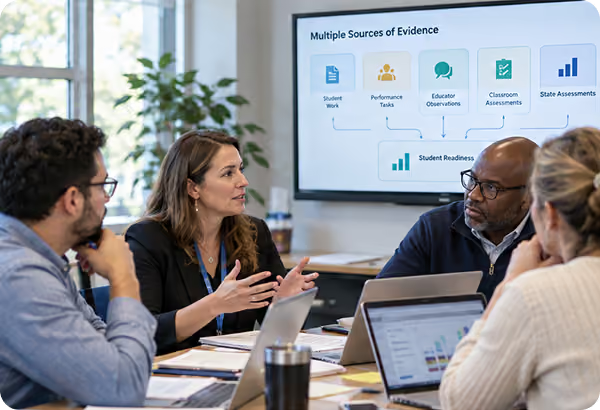
Research matters: multiple sources of evidence supporting student readiness
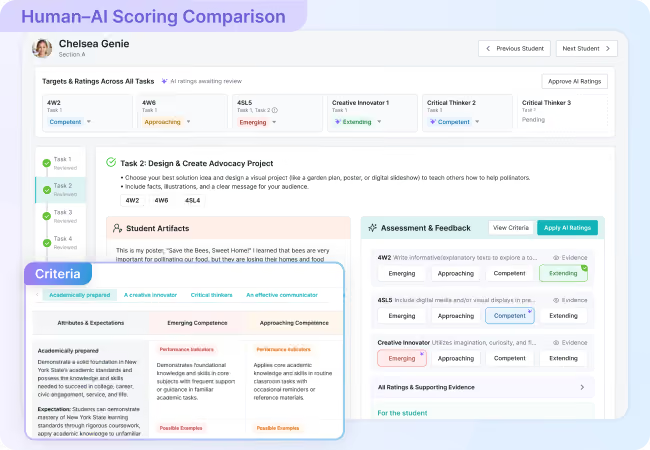
Human and AI scoring comparison

What We Are Studying

The study compares AI-generated rubric scores with trained K–12 educator ratings to explore how AI can scale high-quality performance assessment without replacing teacher judgment.
  • How closely AI scoring agrees with trained human raters.
  • Where teachers and AI disagree — and why.
  • Which types of student evidence can be evaluated reliably by AI, and which still require human judgment.
  • Whether evidence from projects, presentations, portfolios, and career-connected learning can support consistent assessment of durable skills.
  • Whether carefully designed AI follow-up questions can surface student thinking not evident in the final product—without leading the student or changing what is being measured.

Safeguards

  • No AI score will determine a student's grade, placement, graduation status, or other high-stakes decision during the research study.
  • Student information will be handled under applicable district privacy requirements, FERPA, research agreements, and institutional review procedures. Student artifacts will be de-identified where appropriate.
  • Teacher and student results will not be used to rank individual teachers, classrooms, or schools.
  • Any later phase involving direct student interaction with an AI elicitation agent would require separate district approval and appropriate research and privacy review.
Safeguards for responsible and privacy-conscious research

What Participating Districts Receive

Participating districts receive research findings, calibration insights, and practical recommendations for strengthening competency-based assessment.

An aggregate human–AI reliability and calibration analysis.

Findings identifying which competencies and artifact types are most—and least—amenable to AI-assisted evaluation.

Recommendations for improving local competency rubrics and performance-assessment practices.

Early research insight relevant to implementation of Portrait of a Graduate, project-based learning, capstones, CTE, and career-connected learning.

Opportunities for participating educators to contribute practitioner expertise to a rigorous university research study.

How the Partnership Works

University Research Partners

Lead psychometric design, human–AI calibration, reliability analysis, and validity research.

Learning Genie Inc.

Provides the technology environment, rubric and evidence-management infrastructure, and implementation support.

Districts and educators

Provide the human benchmark and authentic instructional context needed to determine whether the approach works in real classrooms.

Become a Research Partner

We are seeking districts and County Offices of Education and BOCES interested in participating as research and field-validation partners. Initial participation would include identifying a district liaison, a small group of interested educators, appropriate existing student performance evidence, and collaboration on research and privacy requirements.

Join the Research Partnership